

 12 min read
 Updated on October 8, 2026
Hidden secret games are built on a single premise: something is right in front of you, but you must first perceive it.
An object might be obscured by another item, camouflaged against the background, positioned in an unlikely spot, or crafted to mimic its surroundings. While spotting these items may seem simple initially, a cluttered scene can rapidly escalate into a genuine challenge.
That is the essence of why these games are so engaging. They weave observation, attentiveness, visual analysis, and patience into a puzzle that rewards careful scrutiny rather than impulsive action.
Whether you are hunting for hidden objects, secret items, differences, clues, or subtle anomalies, a few straightforward techniques can make the search significantly easier.
A shining crack in a cave wall. A button that stays idle until pushed five times. A stage that reveals itself once every single star is captured. It is experiences like these that make secret-loaded games enthralling beyond the point of completion of their core objectives. Whereas the game clearly gives directions, there is always an underlying message about the existence of more.
This article will look at the definition of a video game secret, the psychology of such a discovery, skills developed during the process of search, and methods to discover these secrets.
What Are Hidden Secret Games?
These are the games where there is something you do not know about the game until you come across it yourself. The game has an obvious track, but there are some additional items on the side for the players that like exploring. There are many types of secrets in the games, and among them, there are:
Secret levels – additional levels that can be unlocked once you complete a certain level without mistakes;
Hidden collectible objects – coins, stars, gems, and other things that you need to find in the game;
Easter eggs – jokes or funny items that are left in the game by its developers;
Secret characters or skins – characters and their skins you can unlock through certain achievements;
Secret passages – walls or tiles that are opened with your actions;
Codes that act like cheats.
For instance, the level may depict a cluttered room and ask you to locate:
- A key
- A toy
- A concealed book
- A specific item of clothing
- A miniature animal
- A lost item
- A secret symbol
The game is rarely about maneuvering a complex character. Instead, the objective lies in careful observation and discerning an element that isn’t easily noticeable
Why Are Hidden Secret Games Challenging?
The problem is that the game does not inform the player of the object of the search. In a normal level, the task is presented clearly: get to the end point, clean up the field, pick up the stars on the list. In a hidden secret game, there is always no knowledge if there is one and, thus, every minute spent on searching becomes more of a question. This element of unpredictability is even harder than the most complicated puzzles where there is always the answer.
There is not much feedback along the way as well. An incorrect answer does not provide any messages, sounds or hints of being close to the solution, so it is up to the players to make up their mind when to keep looking and when to change the direction. Plus the fact that most levels provide dozens of objects that can be clicked on, pushed and walked around.
It is easy to see how fast the number of possibilities becomes big. In general, hidden secret games tend to reward the player for making a combination of a couple of clues: finding one strange object and performing a certain action based on that information.
Sometimes, it happens that a person will look straight into an object several times but does not recognize the object since it fits perfectly with the scenery.
That is why effective searching needs more than just focusing on the screen.
You need to have a technique.
1. Split Screen
The most straightforward way would be to split the screen.
Instead of going through the whole screen all at once, you can start with one end of the screen and go through the rest of the scene very carefully.
Here is an example of how to do that:
top left → top right → center → bottom left → bottom right
After completing one section, it is always best to mark it as seen.
In that way, you avoid checking the same spot again without paying any attention to other parts of the screen.
2. Look for Shape First Instead of Color
At times, the object is hard to locate because of the similarity of color to that of the background.
Under such circumstances, search by color is less effective.
Look for the object based on shape and outline.
If, for instance, the required item is a key, look for a thin object having a circle or some weird end rather than seeking for something that is either yellow or silver.
The shape will be identifiable despite the blending color with the background.
3. Look for Objects Out of Context
When searching for hidden objects, it would be better to ask:
“What seems to be out of context here?”
There could be several books in the room, but one object among them can have a shape that is odd to that context.
Similarly, there may be plenty of plants in the garden, whereas a toy could be hidden among them.
Rather than searching for just the same object as presented in the task, search for out-of-context objects.
4. Inspect Crowded Spaces Cautiously
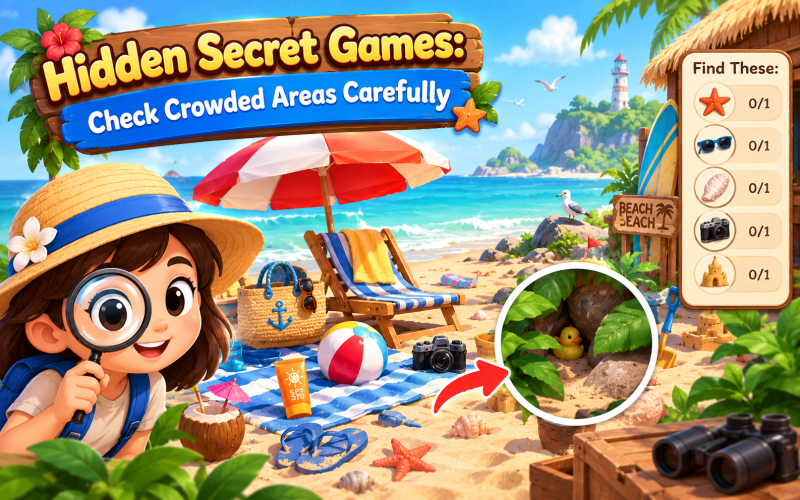
Many players assume that an empty stretch of sand is the most likely place to find a hidden object, because there is nothing there to cover it. In practice, crowded spaces work far better as hiding spots. A busy beach scene gives the artist plenty of cover, and a small item can sit right in the middle of it without drawing any attention.
An object can easily blend in with:
- Seashells
- Pebbles and driftwood
- Seaweed and kelp
- Starfish and crabs
- Beach towels and umbrellas
- Sandcastles and buckets
- Rock pools and coral
Where many objects are clustered together in one space, it is better to move slowly than to skip the spot. This is because the target could be tucked between two other objects, such as a tiny key beside a curled shell, or a pearl resting in the shadow of a rock. A quick glance sees only a pile of shapes, while a slow sweep reveals the one piece that does not belong.
5. Don’t Forget the Edges
There is a tendency for people to focus on the center of an image naturally.
This makes the edges easy to ignore.
Look at:
- corners
- top edges
- bottom edges
- behind large objects
- near doors and windows
- along the border of the picture
Remember that you need to check the whole frame.
6. The Size of the Target is an Indication
When the game gives information regarding the object that needs to be located, consider the probable size.
It is unlikely that the target will be as big as the chair or a table. If you have been instructed to find something small, look for places where the object can be placed.
The examples include:
- On the shelf
- Under some other object
- Next to the book
- Near some furniture
- Behind some decoration
Consideration of the size of the object will make your search easier.
7. Compare Similar Items
There are some secret hidden games where the target is placed next to other objects which look alike.This can make identification difficult.You will find different round items, but you must identify a particular one.
Don’t rush past them. Compare their:
- Shape
- Size
- Edges
- Orientation
- Color
- Details
The difference may be very subtle.
8. Alter Your Approach to Search
Approaching the search in the same manner over and over again will rarely do any good.When you have thoroughly searched the scene but failed to locate the object, try a different approach.
Search for the object:
- From left to right
- From top to bottom
- By object category
- By color
- By shape
- Around big objects
- On the borders
A new search approach might show you something that was hidden from you before.
9. No Need to Be Hasty Because of the Timer
There are some hidden objects games that have a timer. Timer may be one of those things that makes people click fast, but in most cases, rushing leads to making more errors.
When you look around too fast, you might not see some of the details.That’s why it’s better to go with a regular pace.
Just look, move on to the next part, and keep going.
10. Remember Where You Have Already Searched
In case your game does not alter the scene, it is important to remember where you have already searched.
Remember what places you have searched before.
For instance:
“I already searched the whole left portion, so I will focus my attention on the right portion.”
This helps in avoiding wasted efforts and makes your search systematic.
Especially if you have a huge hidden-object level.
11. Take Breaks from Harder Levels
There may come a time when you’ve stared at the same screen for too long that all of it seems familiar. In this situation, staring at the screen won’t be the right thing to do. Give yourself a short break and then try to go back to that level.
Upon your return, the whole scene might just seem easier to examine since you are going to look at it with new eyes.
This does not necessarily mean that all the hard hidden objects will suddenly become clear to you.
12. Utilize Clues Wisely
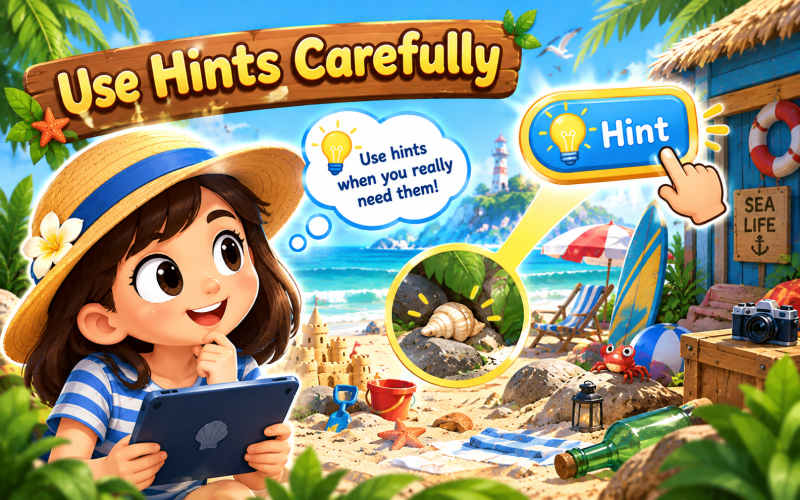
Some hidden secret games also offer clues.
Sometimes, using a clue could be helpful for you when you have really looked through the scene and could not find the last object.
But the use of a clue right away could reduce the level of difficulty.
A better way would be:
Look around → change tactics → look around → use a clue if needed.
Secrets and Kids: A Soft Approach
A secret is always exciting for children. Some tips will make it even more pleasant:
Begin with something simple. Show a secret while playing some simple game to teach them what it means to search for a secret.
Ask them instead of answering. “Is there anything different here on this screen?” makes them find out.
Praise their observations. Telling “You found that tiny detail” makes them pay attention to details rather than the prize.
Have them explain it to you. Ask your child to show a secret they have found. Explaining it improves communication.
Be aware of the time. Make sure that they know how long they can play before going to bed.
Create Your Own Secret Game at Home
It will take just minutes to design your own game without any electronics.
First, draw a simple map on a big piece of paper, including a starting point, a pathway, and a finish line.
Then, include three secrets: a bonus square covered by a piece of paper, a “secret door” revealed when one of the corners is folded, and a secret note written in lemon juice (appears when the paper is held close to a lamp; it has to be an adult who does this part of the game).
Finally, give the players the task, but not the secrets – they have to discover everything themselves.
Discuss your findings after you finish the game and switch roles to let another player design a new map.
Designing secrets will help kids understand the process of clue making.
Frequently Asked Questions About Hidden Secret Games
Bonus tends to be announced, like a reward displayed on-screen. Secret, on the other hand, is not announced and players have to uncover it themselves through exploration and experimentation.
No, hidden secret games do not. Many secrets are easy enough for beginners and discovering them is one way to gain confidence for them.
Secrets help create replay value for games, encourage curiosity, and provide a chance for the developers to leave their mark on the game.
Not really. Some players like to find out everything on their own, while some players would rather be hinted. Whichever method suits your style is fine.
By trying them out. Interact with it from a number of angles, repeat an action or come back to it when you have a new item. If nothing works, it is most likely just a decoration.
Final Thoughts
Secrets in games satisfy the part of us that wants to find out what comes next in the game. It teaches us how to observe carefully, experiment patiently, and maintain curiosity both at work and at school. The trick is to look into the corners of the screen, take any oddities as hints, and have fun from the fact that you are expected to discover something.
If you liked this guide, we encourage you to visit our game Hidden Secret Game. In case you want to know how the tradition of secrets appeared in video games, we encourage you to read overview of Easter eggs. And don’t forget to play our free puzzle and casual games at GamesDesert.