

 10 min read
 Updated on October 8, 2026
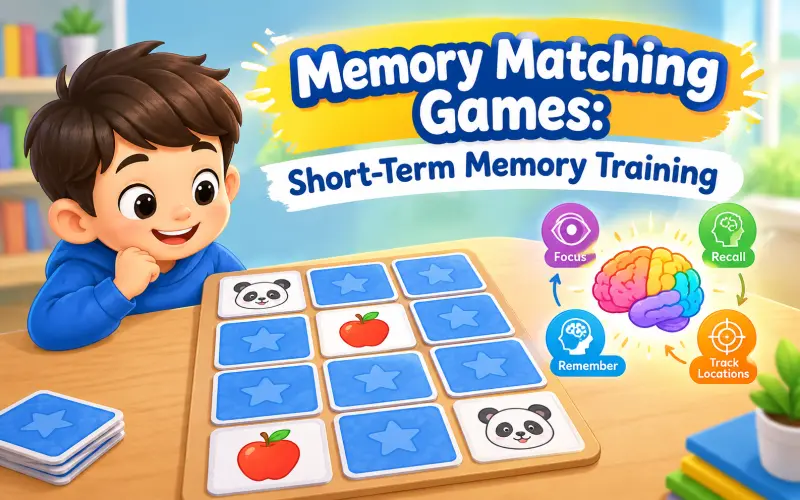
you proceed to flip another card and discover a red kite. Afterwards, you proceed to place the cards back down, requiring you to recall the location of that fish. A children’s game has remained a favorite for generations because memory matching games are designed to do this brief experience. It requires your brain to remember information for a few seconds and then apply it.
Here we examine the nature of short-term memory, a seven-day practice plan, the exercises that memory matching games use to enhance short-term memory, the skills they strengthen, how to play smarter, and the limitations and limitations of these games.
What Is Short-Term Memory?
When we talk about Short-term memory, it is about the mental notepad you use for information you need right now: the phone number you dial, the shopping list you have in your hand while you walk down the aisle, or the first part of a sentence you read before you get to the end.
This notepad is tricky for two reasons:
It is small: Researchers estimate that people can hold about four to seven separate pieces of information at one time (although this number varies from person to person and depending on what is being held).
It fades rapidly: If you do not repeat or pay attention to a new piece of information, it can fade within seconds. The active version of this skill, in which you both hold information and use it (e.g., while solving a problem), is often referred to as working memory by psychologists. In a card game, you hold a card and you use it to strategize what you will flip next.
Memory Matching Games: How They Work on Your Mind.
A matching round uses a simple loop, but each step asks something different from your mind.
Notice: You look at a card and take in its image and position.
Store: The cardflipsface down, and youholda mentalpictureof “what” and “where.”
Retrieve: Later, a new card appears, and youscanyour memory for a match.
Decide: Youpickbetween a safe guess and ariskierflip.
Update: Each new reveal changes yourmentalmap of the board.
That loop repeats dozens of times in a single round. Every pass gives your short-term memory a small repetition, and that is what makes memory matching games such a natural workout for it.
Five skills are required for these games.
1. Enhanced Visual Memory
Initially, you might only remember an image as “an animal,” but constant practice allows you to recognize nuances such as colors, shapes, and small markings. It is important to recall the specific details of each image instead of just generalizing it as “an animal.” Practice can help in recognizing intricate features like colors, shapes, and minor distinguishing marks.
Remembering the specific characteristics of each picture is crucial, rather than simply categorizing it broadly as “an animal.” With experience, one can train themselves to notice and retain details like colors, shapes, and tiny markings in images.
2. Spatial Memory
Remembering the location of a card is not the same as remembering what it shows. When you remember where you parked or where an item sits on a shelf, players use this location sense to create a mental grid, such as “second row, third from the left.”
3. Sustained Attention
One lapse can cost you two. You are taught to stay with the board for several minutes without drifting off by the game quietly.
4. Pattern Spotting
Similar images, such as two flowers that are nearly identical, are present on numerous boards. Telling them apart sharpens your eye for small differences.
5. Planning and Risk-Taking
Is it advisable to either flip a card that you have never seen before, aiming to acquire knowledge, or engage in gambling on a match that has been forgotten? In a highly stress-free environment, the process of weighing these options involves fundamental strategic thinking.
Keeping Information Available While Searching
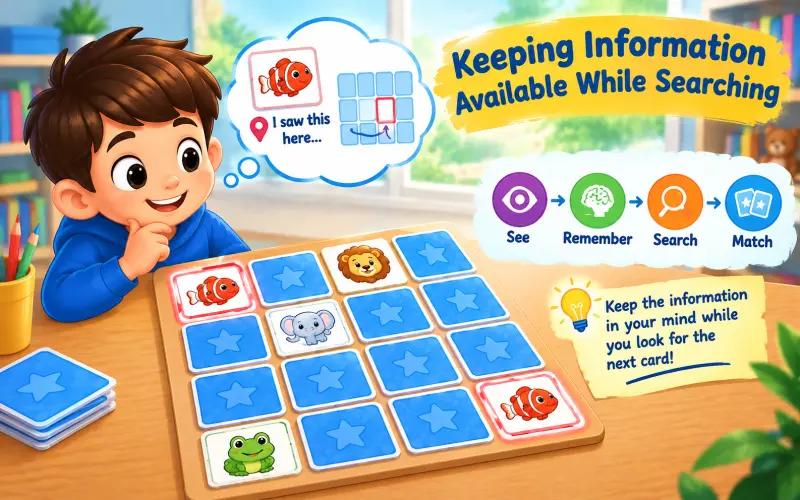
In a memory matching game, one of the fun aspects is that you do not always use information right away; you might find a card early in the game but not find its partner until several turns later, and you must retain the information while viewing other cards. For instance: You show a basketball. You recall the location.
You open three other cards. None matches. You recall where the basketball was. You return to that location when you find the second basketball. The difficulty is not just in remembering a picture but in holding information in a useful way while still working the puzzle.
How Matching Games Encourage Attention?
A simple rule of a matching game is that if you glance away for just a moment, the pair is lost, so these games are a gentle training ground for attention, as players must watch each card as it turns, tune out the distractions around them, and look at the board long enough to catch where each picture lands(nothing moves in the game except what you do).
Many players, after a while, notice that they are better able to pick out minute details, such as a slightly different hue or a miniscule change in a picture.
Memory matching games also model the habit of focusing on something for a few minutes before moving on to something else: for kids, this may be a gentle way to practice sitting with an activity, and for adults, it can function as a brief screen-based break between tasks.
The “one-card pause” is a quick example: After every card you flip, stop for two seconds and silently say what you saw and where it was. This is the next time you play. Observe how much more you remember when you use it, and how frequently your mind wanders without this pause.
Mistakes Can Become Useful Clues
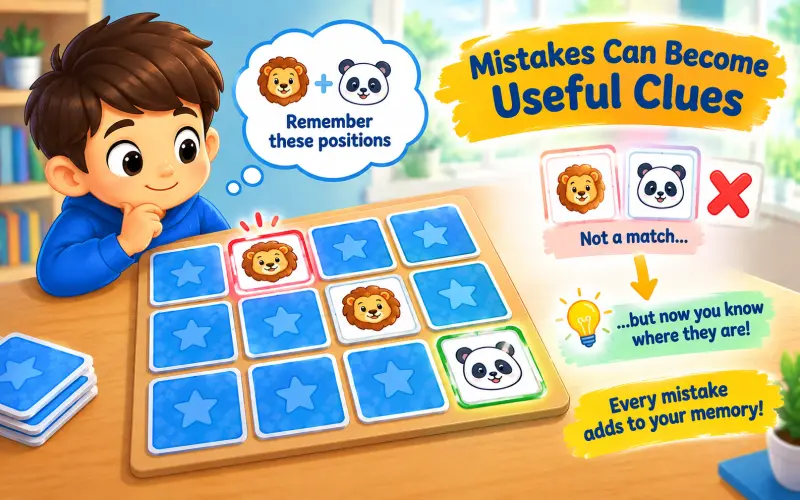
A wrong move in most activities feels like a setback. It is often the opposite in a matching game. You still have something to learn when you flip two cards that don’t match, which is to know what those pictures are and where they are.
When you miss a guess, it transforms into fresh information that you can utilize on your next turn.
Because it shows that mistakes are a step toward the solution rather than the end of the task, this is a healthy way to look at errors. This is utilized by skilled players with purpose.
They treat each reveal as a piece of the map they are building, flip unknown cards early, and accept that most of those first flips will not match.
Because it shows that trying and being wrong is a normal part of learning, this lesson can be especially valuable for kids. In a setting where nothing serious is at stake, memory matching games let players practice this attitude again and again.
Take a moment to envision a scenario where you flip a star and then a moon, only to discover that they do not align. Instead of experiencing disappointment, simply say, “Star is located at the top left, moon is located at the bottom right.”
Once a second star emerges, you are already aware of the precise location where its companion is waiting.
Why Memory Games Are Fun and Challenging!
The combination of easy-to-learn rules and real effort to win is part of the reason that people return to memory games over and over again. The rules are simple: it takes ten seconds to learn how to flip two cards and find a pair, but winning is hard, and the combination of straightforward rules and real challenge keeps people coming back.
The cards are shuffled into a new layout every time, so no two games play out the same, and there is a satisfying “click” when a half-remembered picture turns out to be right, a small win that comes again and again as a single game progresses.
And most memory matching games allow the player to select their own level, which means that a young child and an adult can both find a board that feels challenging but fair.
With the option to play alone, race the clock, or compete with a friend, it is easy to see why a game this simple stays popular with every age group.
Memory Matching Games for Children: How Can They Be Effective?
Memory matching games are a good example of learning that feels like play to children, the rules are short enough for a four-year-old to follow but the game quietly exercises several skills at once: naming each picture builds vocabulary, because a child who says “giraffe” three times in one round is more likely to remember the word; taking turns teaches patience and fairness; and handling a loss gracefully is easier when the game is over in ten minutes and a rematch is just a shuffle away.
Matching also introduces early sorting and sameness, the idea that two things can look alike and belong together, which supports later work in reading and math.
The game is easy for parents and teachers to adapt: use fewer cards for toddlers, themed sets like animals, colors, or letters for preschoolers, and larger boards or timers for older children.
With the flexibility of playing on a table, a floor, or a screen, the game can fit into short gaps in the day, like waiting for dinner or winding down at night.
Frequently Asked Questions About Memory Matching Games
In these games, you are required to flip cards or tiles in order to locate identical pairs. Afterwards, you can utilize your memory to recall the hidden locations of each picture. There are two ways to play these games: either by using physical cards or on a screen. The board can be as small as six cards or as large as sixty.
They mainly use attention, visual recall, and short-term memory. Planning is also a crucial skill for numerous players, as each flip involves the decision between exploring a fresh card and utilizing their existing knowledge.
Not really. A missed pair still shows you two new pictures and their positions, so it gives you information for later turns. Learning from a wrong flip is part of how the game works.
Both have benefits. Solo play lets you focus and track your own progress, while playing with a friend or family member adds turn-taking, conversation, and friendly competition.
Consistent practice typically boosts your performance in the game itself. However, it remains uncertain whether these improvements translate to everyday activities, such as recalling names or managing to-do lists.
It’s wise to view these games as an enjoyable way to exercise your mind rather than relying on them as guaranteed memory solutions. If you have ongoing concerns about your memory, discussing them with a doctor is your best course of action.
Final Thoughts
Memory matching games show that fun games don’t need complex rules. Each round requires you to focus, remember a few things, learn from mistakes, and think about your next step while enjoying yourself. Kids build vocabulary and learn patience, while adults enjoy a quick mental rest away from screens.
The best way to start is with a small board, play for ten minutes, and increase difficulty only when you feel ready. Keep realistic goals too: these games are a good way to sharpen your attention, not a cure for memory problems.
If you liked this guide, check out our article on how puzzles affect the brain, which shows why puzzle games feel so satisfying. For more information about how scientists research short-term and working memory, visit the American Psychological Association. When you’re ready to play, try the free matching and brain games on GamesDesert and see how fast you can finish the board