

 6 min read
 Updated on October 9, 2026
Most lists of the skills puzzles develop sound like a brochure. Better memory, sharper focus, done. That tells you very little. The real value hides inside a handful of specific moments that happen in almost every puzzle, and each moment trains something different.
In this guide, we will walk through those moments one by one. Then you can choose the puzzle that matches the skill you want to build.
The Skills Puzzles Develop Show Up in Six Moments
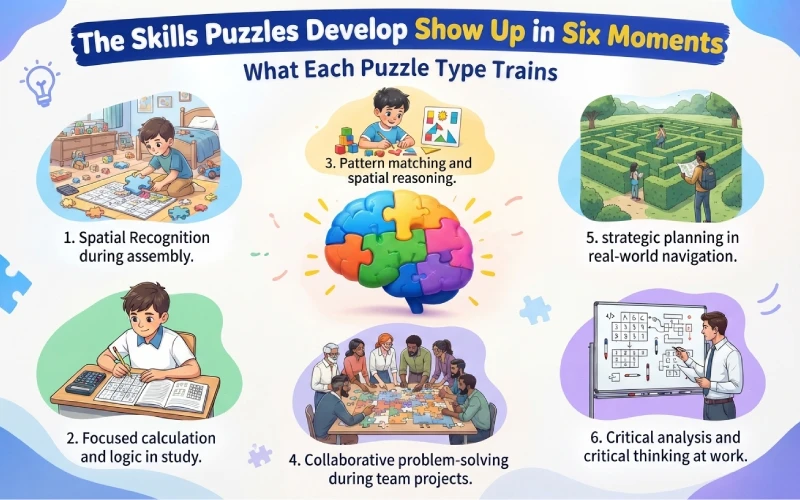
Think about the last puzzle you finished. You did not use one skill from start to end. Instead, you moved through stages. First you looked, then you sorted, then you guessed. After that you probably got stuck, checked your work, and finally finished.
Each stage asks for a different mental habit. Because of this, the skills puzzles develop are easier to understand when you see them in order.
Moment 1: Scanning builds visual attention
Open a 500-piece jigsaw box and pour it out. Your eyes now have hundreds of shapes to process. To find one edge piece, you must ignore everything else.
This is selective attention. It is the same ability you use to find a street sign in traffic or one error in a spreadsheet. Word searches and “spot the difference” pages train it too.
Try this: Set a two-minute timer and find every piece with a flat edge. Then repeat it tomorrow and see if you are faster.
Moment 2: Sorting builds categorizing and planning
Experienced puzzlers rarely start by placing pieces. Instead, they sort. They group by color, pattern, or shape first.
Sorting teaches you to organize a messy problem before you attack it. In other words, you spend a little time on structure so that the later work goes faster. This habit carries over neatly to writing, studying, and project planning.
Moment 3: Guessing builds estimation and risk judgment
Some puzzles need a bold guess. In sudoku, for example, an expert may test a number and see whether the grid breaks. In a crossword, you might pencil in a word you are only 70 percent sure about.
Therefore, you learn to make a guess, mark it as uncertain, and move on. That is a useful life skill. Many people freeze when they lack perfect information, but puzzle solvers practice acting anyway.
Moment 4: Stalling builds patience and flexible thinking
Every puzzle stalls at some point. You stare at the board, and nothing fits.
This is where the most valuable skills puzzles develop appear. Because brute force has stopped working, you must change your approach. You may look at the puzzle from another side, work on a different corner, or walk away for ten minutes.
Notice what this teaches. Being stuck is not failure. It is a signal to switch methods. Riddles and lateral-thinking puzzles make this lesson very clear.
Try this: Next time you stall, write down what you have already tried. Then pick a method you have not used yet.
Moment 5: Checking builds accuracy and error-spotting
Before you finish, you review. Does this crossword answer agree with the letters crossing it? Does every row in the sudoku still hold?
Checking trains you to verify your own work calmly. As a result, you get better at catching small mistakes before they grow into big ones.
Moment 6: Finishing builds satisfaction and motivation
The last piece goes in. It sounds minor, but that small win matters. Finishing gives your mind a clear sense of completion, which many daily tasks never provide.
Moreover, it makes you want to start another one. That repeat habit is how the skills puzzles develop actually grow over weeks and months.
Skills Puzzles Develop, Matched to Each Puzzle Type
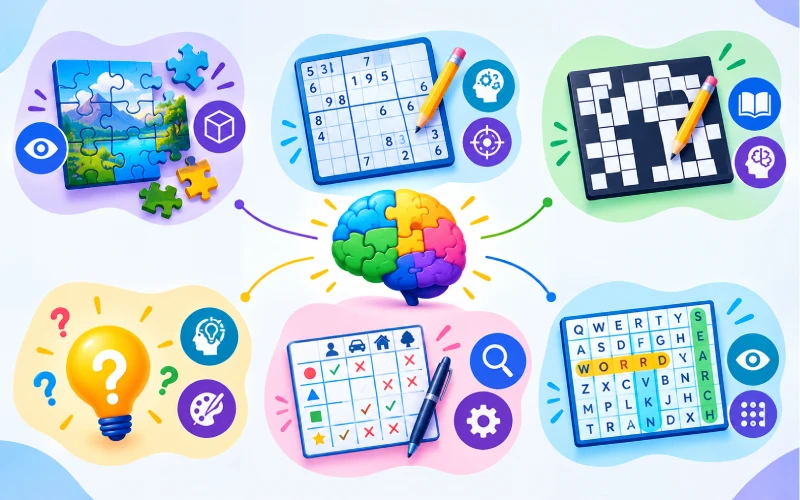
Different puzzles lean on different moments. Use this table to choose.
| Puzzle type | Strongest moment | Main skill trained |
|---|---|---|
| Jigsaw | Scanning and sorting | Visual attention, spatial sense |
| Sudoku | Guessing and checking | Logical elimination, accuracy |
| Crossword | Stalling and recall | Vocabulary, memory retrieval |
| Riddles | Stalling | Lateral thinking, creativity |
| Logic grid | Checking | Deduction, careful reading |
| Word search | Scanning | Pattern recognition, attention |
If you want one skill, pick the matching row. If you want a balanced mind, rotate through several puzzle types across the week.
What Puzzles Cannot Do
Honesty matters here. Puzzles make you better at puzzles. That part is certain. Whether the improvement carries over to unrelated tasks is less clear, and researchers still debate how far brain-training effects travel.
So, treat puzzles as practice, not as a cure. They are a pleasant, low-cost way to keep your mind engaged, and the habits they build, such as patience and structured thinking, can help in other areas. However, they do not replace sleep, exercise, social contact, or medical advice.
Research shows a link between regular puzzle solving and sharper thinking in later life. For example, a study on puzzles and brain health in adults over 50 found that people who did word puzzles often scored better on mental tests. However, scientists still say they need more controlled trials before they can prove puzzles cause the improvement.
How to Train the Skills Puzzles Develop in 15 Minutes a Day
You do not need long sessions. A short routine, repeated, works better than a rare marathon.
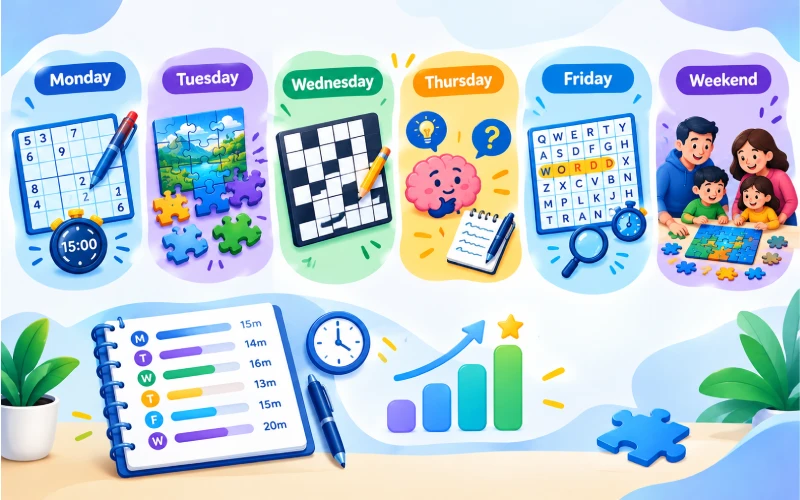
Here is a simple weekly pattern:
- Monday: 15 minutes of sudoku, focusing on checking each row before moving on.
- Tuesday: A jigsaw sorting session. Sort first, place later.
- Wednesday: A crossword. Pencil in your uncertain guesses.
- Thursday: Two riddles. When stuck, write down your failed ideas.
- Friday: A word search against the clock.
- Weekend: A longer shared puzzle with family or friends.
Also, keep a small note of how long each puzzle takes. After a month, those numbers show your progress clearly.
15 tough logic puzzle you must read
Skills Puzzles Develop at Every Age
Children gain shape recognition, hand-eye coordination, and early problem-solving. Simple wooden puzzles and matching games work well.
Teenagers and adults get stronger focus, planning, and stress relief from a quiet task. Meanwhile, older adults often enjoy puzzles as a way to stay mentally active and socially connected, especially when solving with others.
Frequently Asked Question
Young children build shape recognition, hand-eye coordination, patience, and early logic. Puzzles also teach them to keep trying after a first attempt fails.
They give your memory regular practice, especially crosswords and jigsaws, where you recall words or shapes. However, the improvement is strongest for the type of recall you practice.
Jigsaws and sudoku both demand steady attention. Pick the one you enjoy, because you are more likely to keep doing it.
Fifteen minutes is a good starting point. Increase the time only if it stays enjoyable.
Many people find the calm, absorbing focus of a puzzle relaxing. It works best as one part of a healthy routine.
Final Thoughts
The skills puzzles develop are not magic, and they are not random. They appear at clear moments: scanning, sorting, guessing, stalling, checking, and finishing. When you know which moment trains which skill, you can choose puzzles with a purpose.
So pick one puzzle this week, notice where you get stuck, and treat that moment as the real workout.