

 9 min read
 Updated on October 2, 2026
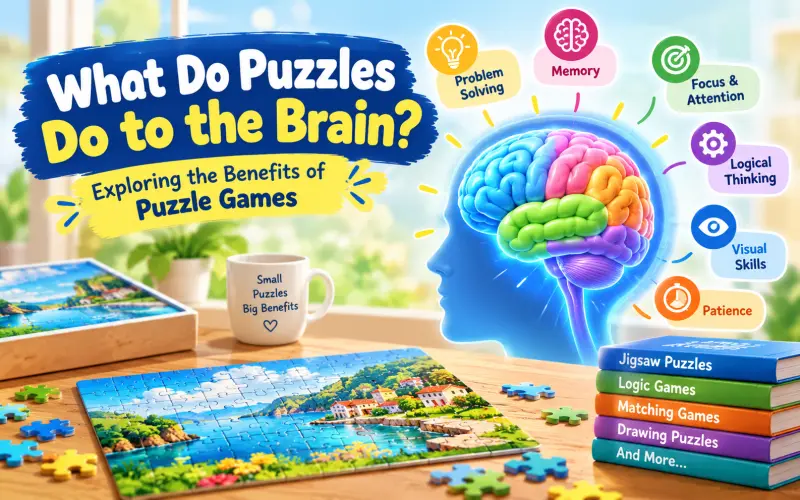
Have you ever pondered what happens to the brain when you spend time assembling puzzle pieces, identifying patterns, recalling items, or figuring out a challenging solution?
There is more to puzzle games than just a means to kill time. You may need to pay attention, retain information, identify patterns, plan your next move, and solve difficulties depending on the kind of puzzle.
For instance, a jigsaw puzzle requires you to piece shapes and use visual information, whereas a logic or drawing puzzle can call for an entirely different strategy. But it’s crucial to maintain the statements’ realism. Puzzle solving requires a variety of mental abilities, but this does not imply that solving puzzles
What Happens in the Brain When You Solve a Puzzle?
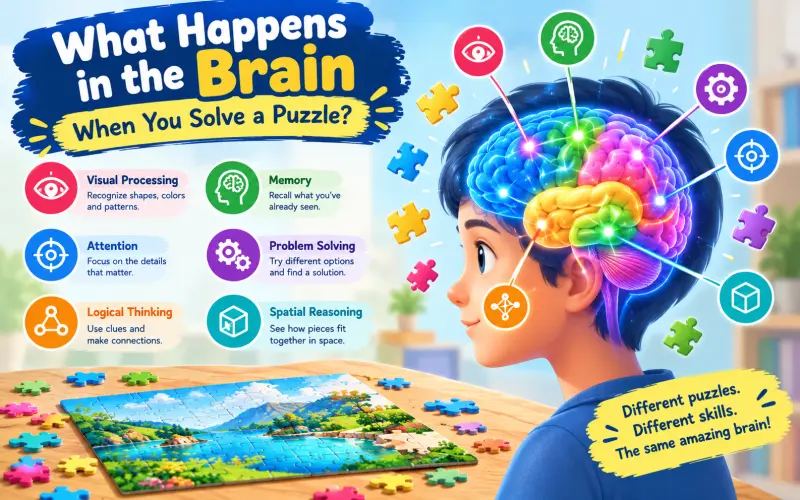
When you start a puzzle, your brain must process information and determine what to do with it.
You may need to recognize a shape, remember where you saw a specific piece, analyze several options, or choose which move should come next. As the puzzle becomes increasingly tough, you may need to modify your method if your first idea fails.
Different puzzles exert varying demands on the brain. A visual puzzle may include recognizing forms and relationships, but a word puzzle may rely more on language and memory.
In other words, there is no unique “puzzle skill.” Different games can test various combinations of mental processes.
Puzzles Can Exercise Problem-Solving Skills
Most puzzle games focus on problem solving.
When faced with a difficult level, there is rarely an obvious response right away. Instead, you should review the available facts, evaluate potential solutions, and test a strategy.
For example, a drawing problem might include a ball, obstacles, and a target. You must determine where to draw a line so that the ball can reach its goal.
Similarly, a jigsaw puzzle asks you to figure out which pieces could go together based on their shape, color, and visual characteristics.
Puzzles Challenge Memory and Recall
Most puzzle games emphasize problem solving.
When presented with a challenging level, there is rarely a clear response immediately away. Instead, you should examine the available information, assess viable options, and test a method.
A ball, barriers, and a target are all possible components of a drawing problem. You must decide where to draw a line so that the ball can reach the goal.
Similarly, a jigsaw puzzle requires you to determine which pieces could fit together based on their shape, color, and visual qualities.
As a result, puzzle games can provide you multiple opportunity to practice breaking down a problem into smaller portions and modifying your method when one answer fails.
Puzzles Require Focus and Attention
A puzzle can be tough to complete if you don’t pay attention to the nuances.
Consider hunting for a single little piece among dozens of similar-looking jigsaw pieces. You must compare colors, patterns, forms, and edges while disregarding parts that do not match.
Similarly, a spot-the-difference game encourages you to carefully scrutinize two similar photographs and identify minor differences.
As a result, puzzle games might inspire sustained concentration while playing. The level of focus required varies according to the puzzle, its difficulty, and the player.
Puzzles Can Encourage Logical Thinking
Logic puzzles need you to use information to draw a conclusion.
You may have multiple options, but some clues will remove some of them. It is possible to find a solution by gradually limiting down the choices.
This style of reasoning appears in several games, including:
- Number puzzles
- Logic grids
- Pattern puzzles
- Matching games
- Strategy puzzles
- Some Maze Games
Rather to guessing at random, players must frequently examine what they already know and apply that knowledge to choose what should happen next.
Visual Puzzles Challenge Spatial Thinking
Some problems rely largely on understanding how items connect to one another in space.
Jigsaw puzzles are one simple example. You must analyze how an item’s shape complements another piece and how its image contributes to the overall picture. Other games may require you to rotate things, navigate a maze, arrange shapes, or figure out where something belongs.
As a result, visual-spatial puzzles offer a different type of challenge than word or number puzzles. These games are especially appealing to players who enjoy visual problem solving.
Puzzle Games Can Encourage Patience
Not all puzzles can be solved on the first try.
Sometimes you will select the incorrect piece, make a poor move, or reach a level where your initial strategy fails. Instead of giving up, you might investigate what went wrong and attempt a different method.
Over time, this develops into a gameplay pattern of attempting, observing, adjusting, and trying again.
That does not imply that riddles inherently make people more patient. However, games can provide an entertaining setting in which persistence is required to complete a challenge.
Different Puzzles Challenge Different Skills
One of the most fascinating aspects of puzzle games is their diversity.
Jigsaw Puzzles
Jigsaw puzzles need visual details, piece forms, pattern identification, and forethought.
For example, when playing an online jigsaw puzzle, you might initially inspect the entire image before organizing scattered pieces into smaller groups.
Matching Games
Matching games sometimes demand players to recall locations, identify comparable things, and make decisions depending on their options.
Logic Puzzles
Logic puzzles emphasize clues, relationships, elimination, and reasoning.
Drawing and Physics Puzzles
Planning, spatial reasoning, and an understanding of movement and physics are all required while drawing puzzles.
You may need to draw a platform that directs a ball toward a target.
Word Puzzles
Word games can test vocabulary, spelling, pattern recognition, and word recall.
As you can see, “puzzle game” describes a very broad category. Two puzzle games can provide completely different experiences and challenges.
Can Puzzle Games Improve Brain Health?
Here, it is critical to distinguish between mental activity and medical claims.
Playing puzzles demands mental work, and several research have looked into how cognitive activities and games relate to cognitive function or brain health. However, it would be an exaggeration to claim that playing conventional puzzle games guaranties greater brain health or prevents illnesses like dementia.
The link between cognitive activity, brain training, and long-term cognitive health is intricate.
As a result, puzzle games should be viewed as a fun type of mental activity rather than a medical treatment or a guarantyd method of brain protection.
A healthy lifestyle consists of numerous components, including physical activity, sleep, social connection, and other aspects of general health.
How Often Should You Play Puzzle Games?
There is no set number of minutes that everyone should spend playing puzzles.
Instead, select the amount of gaming that fits well into your schedule. You can also change the type of puzzles you play. For example, you could work on a jigsaw puzzle one day and then try a logic or matching game the next.
Most importantly, puzzle games should be enjoyable. If a game becomes frustrating, taking a pause can allow you to return with a new viewpoint.
Keeping the Mind Active Over Time
Scientists are still investigating how far these benefits extend. Puzzle play is frequently associated with an active, engaged lifestyle, which is beneficial to long-term brain health, although it is not a guaranty against age-related deterioration.
The most reliable strategy is to combine puzzles with other healthy habits including as adequate sleep, exercise, social connection, and a well-balanced diet.
Exercise for Your Mental Muscles
Your brain, like your body, grows stronger when pushed. Puzzle games train your mind on a regular basis by asking it to remember facts, recognize patterns, and stay concentrated until the solution arrives.
Each time you work through a difficult level, you are asking your brain to coordinate attention, memory, and thinking.
The best aspect is that this type of training seems like playtime. There are no heavy weights or lengthy exercises, just a board, grid, or screen and a bit of curiosity.
Over time, consistent practice can make these mental tasks feel more fluid, whether you’re following a tricky recipe, recalling names at a conference, or switching between many occupations at once.
As with any workout, variation and gradual growth are important. Begin with easy puzzles and gradually increase the difficulty level so that your brain is constantly stretched rather than coasting.
Tips for Getting More out of Puzzle Games
If you want to make your puzzle sessions more engaging, try these simple habits.
Choose Different Types of Puzzles
Don’t limit yourself to one type. Try visual, logic, matching, word, and physics-based puzzles.
Increase Difficulty Gradually
Start with challenges that require some thought but remain manageable. Then move to harder levels as you become comfortable.
Don’t Rush Every Move
Take a moment to understand the available options before making a decision.
Learn From Mistakes
If a solution fails, consider why it failed instead of immediately repeating the same move.
Take Breaks
A short break can be useful when you have been working on the same difficult puzzle for a long time.
Play for Enjoyment
Puzzle games are entertainment first. You don’t need to turn every game into a test of your mental ability.
Try Different Puzzle Games on GamesDesert
If you enjoy testing your problem-solving skills, GamesDesert offers different types of browser games that provide different kinds of challenges.
You can try an Ocean Animals Jigsaw Puzzle if you enjoy visual puzzles and assembling pieces into a complete picture. If you prefer drawing and physics-based challenges, you can also try a Brain Line game and experiment with lines, movement, and gravity.
Trying different puzzle formats can help you discover which types of challenges you enjoy most.
My thoughts on what effect do puzzles have on the brain
Puzzle games are an affordable, enjoyable way to keep your mind curious and active. They improve focus, reward persistence, and offer a short break from a hectic day. Whether you enjoy a quick daily brain teaser or a big jigsaw on the weekend, you are giving your brain something valuable: a challenge to solve. Personally, I find that playing Loop Breakout helps me focus and think more clearly. A few quick rounds during a break are enough to clear my head before I get back to work.