

 18 min read
 Updated on October 9, 2026
A three-year-old turns a puzzle piece around, tries it in the wrong corner, sighs, and tries again. Nothing about it looks impressive. Yet that small loop of guess, test and adjust is exactly the kind of mental work that research on puzzles and cognitive development keeps coming back to.
Nearly every blog on this topic says puzzles build memory, patience and problem-solving. That list isn’t wrong, but it hides the more interesting story. Some benefits are well supported, some are still only correlations, and one of the biggest factors is not the puzzle at all but how an adult talks while the child plays.
This guide separates what the evidence shows from what blogs simply repeat, then turns it into things you can do today: an age-by-age guide, a table matching puzzle types to skills, homemade puzzle ideas that cost almost nothing, and a four-week plan. Adults and older adults get their own honest section too.
What cognitive development actually means
Cognitive development is the process by which a child learns to think, remember, pay attention, reason and solve problems. It is not one skill. It is a bundle, and puzzles touch several strands of that bundle at once.
Three strands matter most for this topic:
- Spatial reasoning: picturing shapes, rotating them mentally and understanding how parts fit into a whole. This is the strand with the strongest puzzle research behind it.
- Executive function: holding information in mind (working memory), switching strategy when something fails (cognitive flexibility) and resisting the urge to grab the nearest piece (inhibition).
- Language and reasoning: describing what you see (“the curved edge,” “the corner with the red roof”) and explaining why a choice failed.
A puzzle is a closed problem with a guaranteed answer and instant feedback: the piece fits or it doesn’t. That combination is rare in a child’s day. Most learning is messy and slow to confirm. A puzzle gives the brain a small, safe arena to practise testing an idea and seeing the result in seconds.
What the research really shows about puzzles and cognitive development
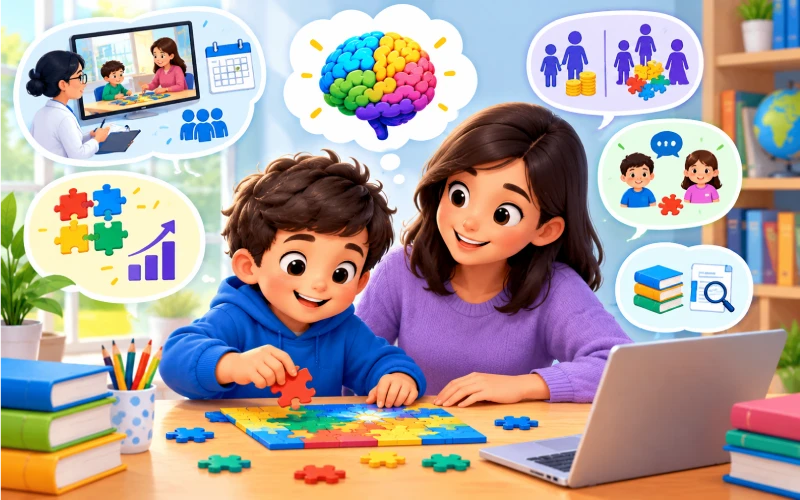
The best-known study here comes from the University of Chicago, led by psychologist Susan Levine. Researchers watched video recordings of just over 50 children playing with their parents every four months between ages two and four. About half of the children played with puzzles such as jigsaws and pegboards at least once during the observations. Those children later did better on tasks that asked them to rotate and move shapes in their minds. The study, “Early Puzzle Play: A Predictor of Preschoolers’ Spatial Transformation Skill,” appeared in the journal Developmental Science (as reported by Nursery World).
Two details from that same study rarely make it into other blogs:
- Higher-income parents offered puzzles to their children more often, so access to puzzles was uneven.
- Boys tended to play with harder puzzles, and their parents used more spatial language. Boys also scored higher on a mental transformation task at four and a half.
Levine herself said more research was needed to know whether puzzle play and spatial language actually cause better spatial skills. That honesty matters. This was an observational study, so it shows a link, not a guarantee.
Other work points the same way. A study published in Frontiers in Psychology watched 31 children aged three to four play with puzzles alongside a parent, looking at how parent talk and child behaviour relate. A separate study of 117 children aged three to five used jigsaws to explore how young children grasp that a picture can be split into pieces and rebuilt. And a 2026 narrative review in the National High School Journal of Science pulled together peer-reviewed studies from 2008 to 2024 and concluded that puzzle-like play is associated with stronger spatial skills such as mental rotation and spatial visualisation, and that spatial ability is still malleable in early childhood.
The honest summary
- Well supported: early puzzle play goes hand in hand with better spatial skills, which are linked to later maths and STEM interest.
- Plausible but less proven: benefits for attention, memory and persistence. These are widely claimed, yet most blog posts cite no study for them.
- Not proven: that any puzzle will “raise IQ” or guarantee school success.
When a page promises a specific percentage boost from puzzles without naming the study, treat it with suspicion. The real picture is quieter, and more useful.
How you talk during puzzles and cognitive development
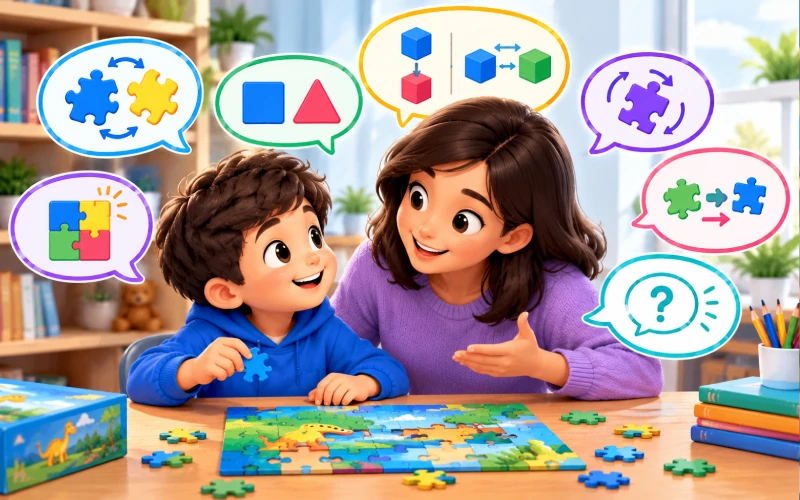
If you read only one section of this guide, make it this one. The studies above keep returning to the same companion variable: spatial language, the words adults use to describe position, shape and movement. The reviewers behind the 2026 narrative review also point to guided interaction, meaning adults who ask questions and describe what they see, as something that can extend a child’s spatial thinking.
In plain terms, a puzzle plus a talkative, curious adult is likely to do more than a puzzle alone. You don’t need special training. You need a handful of habits.
Describe, don’t direct. Instead of “put it there,” try:
- “That piece has a straight edge. Where do you think straight edges go?”
- “It’s too tall for that gap. What could we turn?”
- “You flipped it over. Now the bump points up.”
Ask a question before offering a fix. “What do you notice about this piece?” gives the child a task. “Try this one” takes the task away.
Name the strategy out loud. “You started with the corners. That’s a smart way to begin.” Children copy strategies they hear named.
Use position words on purpose: above, below, beside, between, inside, rotate, flip, slide, match. These words are small, but they give a child the vocabulary to think about space instead of just feeling their way through it.
This also changes how you pick puzzles. Choose ones you can talk about together, with clear shapes and pictures you can describe, rather than a 1,000-piece sky that leaves you both silent.
Puzzles and cognitive development: types and the skills they train
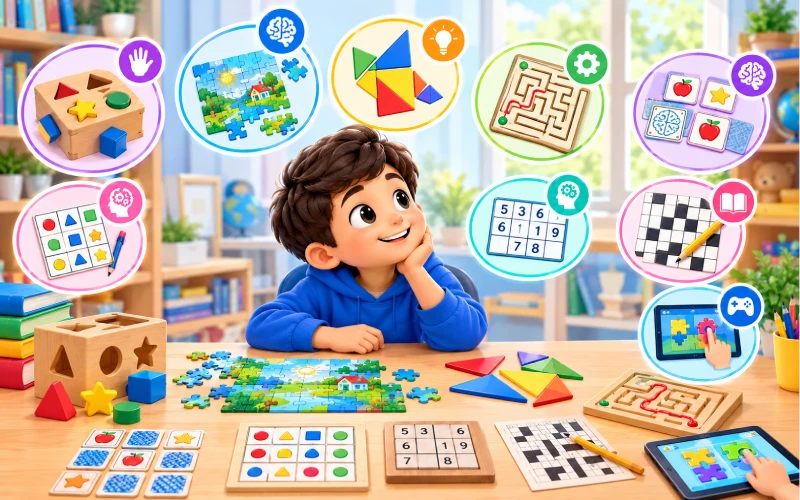
“Puzzle” is a huge category, and each type exercises something different. Matching the puzzle to the skill you want to build works better than buying whatever is on offer. This table is a practical guide based on how each puzzle works, not a list of proven results.
| Puzzle type | Main skill it exercises | Good for | Watch out for |
|---|---|---|---|
| Knob and shape-sorter puzzles | Matching, hand-eye coordination | Ages 1 to 2 | Child may force pieces; show the rotation |
| Jigsaw puzzles | Spatial reasoning, visual scanning, persistence | Ages 2 and up | Too many pieces too soon causes quitting |
| Tangrams | Mental rotation, part-whole thinking | Ages 5 and up | Needs patience; start with outline cards |
| Mazes | Planning ahead, tracking paths | Ages 4 and up | Dead ends can frustrate; trace with a finger first |
| Memory and matching games | Working memory, attention | Ages 3 and up | Competition can overshadow the thinking |
| Logic grid and sequence puzzles | Deduction, flexible thinking | Ages 7 and up | Needs reading and basic number sense |
| Sudoku and number puzzles | Rule following, working memory | Ages 8 and up | Guessing instead of reasoning |
| Crosswords and word puzzles | Vocabulary, retrieval from memory | Ages 9 and up | Can feel like a test if clues are too hard |
| Digital puzzle games | Varies by game; often logic and speed | Ages 6 and up | Choose games without timers or constant ads |
A healthy puzzle shelf mixes types. A child who only does jigsaws will get very good at jigsaws. Adding a maze, a memory game and a tangram set exercises more of the thinking toolbox.
Puzzles and cognitive development by age
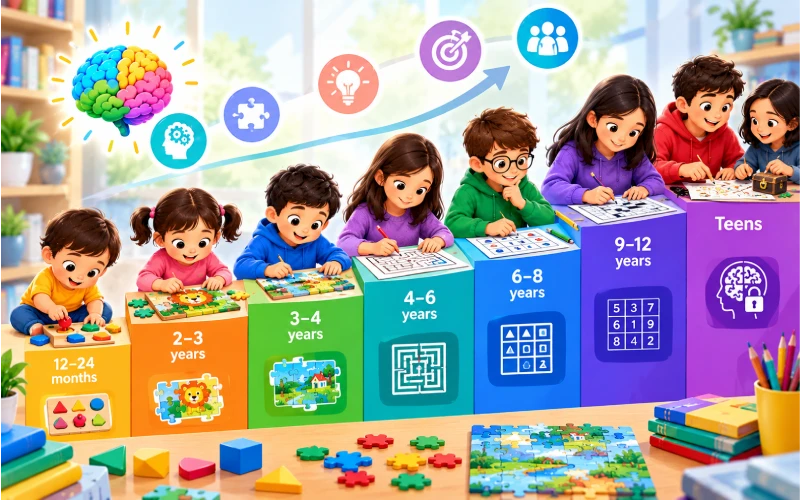
When it comes to puzzles and cognitive development, the right puzzle sits just above what a child can already do, close enough to reach with a little help. Psychologist Lev Vygotsky called that gap the zone of proximal development. Too easy and the child is bored. Too hard and the child gives up. The piece counts below are rules of thumb from common practice, so adjust them to your child rather than the calendar.
| Age | Start with | Move up to | What to practise together |
|---|---|---|---|
| 12 to 24 months | Chunky knob puzzles with 1 to 3 pieces | Simple shape sorters | Naming the object, turning the piece |
| 2 to 3 years | 4 to 8 piece wooden or foam puzzles | 12 piece jigsaws with a clear picture | Edge pieces, matching colours |
| 3 to 4 years | 12 to 24 piece jigsaws | Floor puzzles, memory card games | Position words, describing the picture |
| 4 to 6 years | 24 to 48 pieces, simple mazes | Tangram outline cards, pattern sequences | Planning a route before drawing it |
| 6 to 8 years | 48 to 100 pieces, easy logic puzzles | Mini sudoku, riddles, rebus puzzles | Explaining why a move failed |
| 9 to 12 years | 100 to 300 pieces, tangrams | Sudoku, logic grids, crosswords | Choosing a strategy, then checking it |
| Teens | 500 piece jigsaws, cryptic or logic puzzles | Escape-room style puzzles with friends | Working in a team, dividing the problem |
A few notes that most guides skip:
- Regression is normal. A child who whizzed through 24 pieces may struggle with a new picture style. That isn’t a step backward.
- Picture complexity matters as much as piece count. A 24-piece puzzle with a plain background is harder than a 40-piece one with distinct objects.
- Repeat favourites. Redoing a solved puzzle builds speed and confidence, and gives the child a chance to try a new strategy on a known problem.
Productive struggle: helping without taking over
Every parent knows the moment. The child is stuck, the frown deepens, and your hand drifts toward the right piece. Resist, for a minute. The thinking happens in the struggle, not in the finished picture.
Struggle is only productive while the child is still trying things. Once they are throwing pieces or going blank, it has tipped into frustration and learning stops. A hint ladder helps you stay on the right side of that line. Move down one rung at a time, and only when the child is truly stuck:
- Wait. Count to ten silently. Many children solve it in that gap.
- Narrate what you see. “You’ve tried three pieces in that corner.”
- Ask a pointing question. “Which piece has a flat edge like this one?”
- Narrow the field. Move three or four pieces closer and set the rest aside.
- Show one step, then hand it back. Place a single piece, then say “Your turn. What’s next to it?”
The goal is for the child to feel that they solved it, with you as the support. A child who hears “you worked that out” builds a very different relationship with difficulty than one who hears “let me do it.”
If a puzzle stays too hard for several sessions, put it away without comment and bring it back in a few weeks. That is not failure. It is timing.
Screens or wooden pieces? What digital puzzle games can and can’t do
Many children now meet puzzles first on a phone or tablet, so the question of digital puzzles and cognitive development deserves a straight answer: the evidence is promising but thin, and it depends heavily on the game.
A 2023 study of 6 to 7 year olds in Russia, published in Psychological Science and Education, grouped digital games into six types (quick reaction, logic, educational, strategy, drawing and simulators) and compared them with children’s working memory and inhibition scores. Different game types related to different executive function skills, which suggests that “digital game” is too broad a label to say anything useful. Because the study compared preferences with test scores, it can’t tell us that the games caused the differences.
A Turkish quasi-experimental study, listed in the Hacettepe University repository, designed an educational game for five and six year olds around working memory, flexibility and inhibitory control. The children who played it improved on an executive function measure compared with the control group. That is encouraging, but it is one purpose-built game, not a license to say any app works.
Here is a sensible middle path:
- Use digital puzzles as a supplement, not a replacement. Physical pieces give hands-on practice with turning and fitting that a swipe doesn’t fully copy.
- Choose games with no countdown timers, no pop-up ads and no pressure to buy. Speed pressure works against careful thinking.
- Sit with younger children and use the same descriptive language you would use with wooden pieces.
- Prefer games that get harder as the child improves, so the challenge stays in the sweet spot.
- Cap the time. A short, focused session of 15 to 20 minutes usually beats an hour of tapping.
Homemade puzzles for cognitive development that cost almost nothing
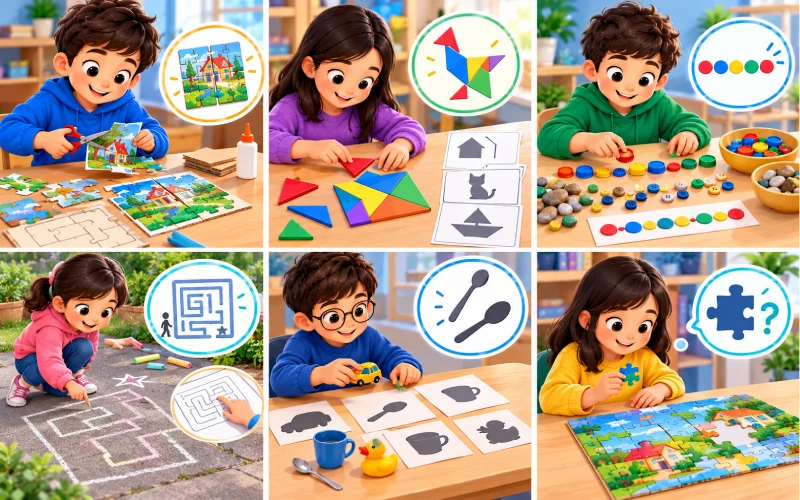
Here is a gap in almost every article on this topic: they quietly assume you can buy a stack of wooden puzzles. Many families can’t, and the research doesn’t say you need to. What the studies describe is play with shapes, fitting and spatial talk. You can build all of that at home.
1. Cardboard jigsaw. Cut a clear picture from an old calendar, magazine or cereal box. Glue it to thin cardboard and cut it into 4, 6 or 12 pieces with scissors. Start with straight cuts, then move to curved ones. Draw the same picture’s outline on a sheet underneath so younger children can match pieces to it.
2. Tangram from a card. Cut a square into seven standard shapes: two large triangles, one medium triangle, two small triangles, a square and a parallelogram. Draw simple outlines (a house, a cat, a boat) for the child to fill in.
3. Sorting and pattern play. Bottle caps, pebbles, buttons or seeds can be sorted by size and colour, then arranged into patterns: big, small, big, small. Ask the child to continue the pattern or spot the mistake you hid.
4. Chalk maze. Draw a maze on the ground with chalk, or scratch one in dry sand. Let the child walk it first, then trace the same route with a finger on paper. Walking turns planning into something the body understands.
5. Shadow matching. Place familiar objects such as a spoon, a cup or a toy on paper and trace their outlines. Mix up the objects and ask the child to match each one to its shadow shape.
6. Missing-piece game. Complete a simple jigsaw, secretly remove one piece and ask, “What’s missing and how do you know?” The child has to describe the shape of a gap.
For classrooms and learning centres, these activities scale well. A teacher can prepare ten cardboard puzzle sets from one afternoon of scrap material, and children can swap sets to keep things fresh.
A simple four-week puzzle plan
For puzzles and cognitive development, habits beat intensity. Fifteen minutes, four or five days a week, is easier to keep than a long weekend session that never happens. Here is a plan you can copy and adjust.
| Week | Focus | Daily activity (10 to 20 minutes) | Your job |
|---|---|---|---|
| 1 | Getting comfortable | One familiar puzzle, slightly easy | Notice and name what the child does well |
| 2 | Position language | A new puzzle one level up | Use three position words every session |
| 3 | Strategy | Alternate jigsaw and a maze or tangram | Ask “What will you try first?” before they start |
| 4 | Independence | Child chooses the puzzle and sets it up | Step back; use only the hint ladder if stuck |
At the end of week four, look for small signs rather than test scores: Does the child stay with a puzzle a little longer? Do they describe what they are doing? Do they try a second idea after the first fails? Those are the behaviours puzzles are meant to build.
Common mistakes to avoid
- Buying for the age on the box instead of the child. Age labels are a marketing range. Watch your child, not the packaging.
- Solving it for them. It feels kind, but it removes the exact experience that builds the skill.
- Turning it into a race. Timers and “who finishes first” reward speed over careful thinking, and some children simply stop trying.
- Praising the result only. “You’re so smart” teaches that ability is fixed. “You tried a different corner and it worked” teaches that effort and strategy matter.
- Comparing children. Siblings and classmates move at different speeds. Remember that the research itself shows large differences in how often children get to play with puzzles at all.
- Giving the same puzzle type forever. Variety keeps more of the thinking toolbox in use.
- Expecting miracles. Puzzles are one good activity among many. Sleep, conversation, outdoor play, reading together and time with other children all matter for cognitive development too.
If a child persistently avoids puzzles and other hands-on activities, or seems to struggle with attention, language or movement across many settings, mention it to a paediatrician or a teacher. Puzzles are a good activity, not a screening test, and they shouldn’t be used to diagnose anything.
Puzzles and cognitive development in adults and older adults
The story of puzzles and cognitive development doesn’t stop at childhood, and this is where headlines get the most carried away. So here is the careful version.
In 2019, researchers at the University of Exeter and King’s College London reported on more than 19,000 adults aged 50 to 93 in the online PROTECT study. People who said they did word and number puzzles such as crosswords and Sudoku more often scored better on tests of memory, attention and reasoning. Lead researcher Dr Anne Corbett said the improvements were clearest in speed and accuracy. You can read the University of Exeter summary of the findings.
The catch is in the design. The Alzheimer’s Society commented that the study shows puzzling and thinking skills are linked, not that puzzling improves thinking skills, and that it did not look at dementia risk. People with sharper thinking may simply enjoy puzzles more.
The wider brain-training literature adds another layer. A Psychiatric News report describes “narrow transfer”: you get better at the exact kind of task you practise, but that doesn’t reliably carry over to unrelated skills such as general memory. BrainFacts, summarising a 2016 review, reached a similar conclusion, while noting that one large trial (ACTIVE) found that speed-of-processing training was linked to lower dementia odds ten years later.
So what should an adult take from all this?
- Enjoy puzzles for their own sake. Focus, calm and a sense of achievement are real benefits, whatever the long-term effect on the brain.
- Don’t treat puzzles as dementia insurance. Exercise, blood pressure control, sleep, social contact and learning new things all have a stronger evidence base.
- Vary the challenge. Moving between word, number and spatial puzzles, and trying something you are not good at, asks more of your brain than repeating the same grid.
Frequently asked questions about puzzles and cognitive development
Most children can begin around 12 months with chunky knob puzzles of one to three pieces. The aim at that age is exploring shapes and fitting, not finishing a picture. Move to four or more pieces as the child gets confident.
The research links early puzzle play to stronger spatial skills, which relate to maths and STEM learning later on. There is no solid proof that puzzles raise general intelligence. Think of them as a good way to build specific thinking habits, not as a shortcut to a higher IQ.
Short and regular works best. For toddlers, five to ten minutes is plenty. For school-age children, 15 to 30 minutes is a good range. Stop while the child is still interested.
Puzzles can be a useful, low-pressure way to practise sustained attention, and many children enjoy them. But they are not a treatment, and the evidence for puzzles specifically is limited. Talk to your child’s doctor or school about proper support.
Not necessarily. The evidence is early and varies by game. Physical puzzles give hands-on practice, while well-designed digital games can add variety. Use both, keep sessions short and avoid timers and ads.
Regular puzzlers tend to score better on thinking tests, but studies so far show a link, not proof that puzzles protect the brain or prevent dementia. Enjoy them, and pair them with exercise, sleep and social activity.
Final thoughts
The link between puzzles and cognitive development is real, but it is more specific and more human than most posts admit. Spatial skills have the strongest backing. Attention, memory and persistence are plausible but less proven. And the adult sitting beside the child, describing shapes, asking questions and holding back the urge to fix things, may matter as much as the puzzle itself.
You don’t need an expensive set. A cardboard jigsaw, a handful of bottle caps and ten relaxed minutes will do more than a shelf of unused boxes. Pick one idea from this guide, try it this week, and watch how your child tackles the next stuck moment. That moment is where the learning lives.
Which puzzle does your child love most, or which one do they refuse to touch? Share it in the comments; real examples help other parents and teachers more than any list.