

 10 min read
 Updated on October 6, 2026
Most advice about puzzle game strategies boils down to two lines: take a break, and think outside the box. Both are fine. Neither one tells you what to do in the next ten seconds, while you stare at a level that refuses to open.
This guide is different. It gives you nine concrete puzzle game strategies, and each one is a small action you can take right now. Some help before your first move. Others help while you test ideas, and a few help when nothing works. After that, you will find advice for each puzzle genre, a short practice routine and an FAQ.
If you are brand new to the genre, read our list of the best puzzle games for beginners first. Then come back here and use these methods on whatever you pick.
Read the puzzle before you touch it
Every puzzle is a tiny rulebook, and the game rarely prints it for you. Instead, you rebuild the rules from what you see. The first three puzzle game strategies help you do that before you waste a single move.
1. Name the verbs
Ask what the game lets you do. Push, rotate, connect, swap, place, wait. Those are the verbs. Most puzzle games hand you between one and four of them at a time, and a level is usually an excuse to combine them in a new way.
Say the verbs out loud or jot them down. A block-pushing level might give you only “push” and “pull.” A physics level might give you “place,” “launch” and “stop.” Once you know the verb list, the number of possible moves drops sharply. You stop wondering what could happen and start asking which verb fits here.
Also notice which verb is new. When a game introduces a verb, the next few levels usually teach it on its own before mixing it in. Therefore, the newest verb is a strong clue to the trick.
2. Sort the board into fixed and movable
Draw a mental line down the screen. On one side, put everything that never changes: walls, anchors and goal tiles. On the other side, put everything you control. Then study the fixed side first.
The fixed things are the real puzzle, because the movable things are only your tools. A wall that sits one tile too far to the left often tells you where a piece must stop. A goal tucked into a dead end tells you which direction the final move must come from.
This habit also saves you from a common trap: pushing at something that cannot move. If three attempts fail, check whether the object is secretly fixed.
3. Treat unused pieces with suspicion
Level designers rarely place things by accident. If a piece, tile or item seems to do nothing, assume it matters until you prove otherwise. Writers call this idea Chekhov’s gun: if a gun hangs on the wall in act one, it fires by act three.
Puzzle games follow the same logic. A lone button, an odd color or a strange gap is seldom decoration. So list every object on screen and ask what each one does. The one you cannot explain is your next experiment.
Of course, some games hide decoys on purpose, especially in later levels. Even then, proving that something is a decoy counts as progress.
Test your ideas the smart way
Once you understand the board, you still have to try things. These four puzzle game strategies make every attempt teach you something.
4. Spend a move to buy information
New players treat every move as a bet on the final answer. Strong players treat early moves as questions. Push the block somewhere harmless to see how it slides. Fire the shot at nothing to see where it lands.
Think of it as buying information. Moves cost something, whether that is a step counter or just your patience, but information pays you back at once. One deliberate test teaches you more than three hopeful guesses.
However, test only when undo or reset is cheap. If the game punishes a wrong move heavily, spend your thinking first and your moves second.
5. Work backward from the goal
Forward thinking asks what you can do from the start. Backward thinking asks what the final move must look like. In many puzzles, the end state is far more restricted than the start, so it is easier to reason about.
Take a block-pushing puzzle. Suppose the last box has to enter the goal from the left. Then a clear tile must exist on its right at that moment. Next, ask how a box reaches that tile, and keep going. Each step backward shrinks the search. After three or four steps, you often meet your starting position in the middle.
The same method works in lock-and-key puzzles. Start from the locked door and ask what opens it. Then ask what opens that.
6. Start where the puzzle is most cramped
Find the tightest spot on the board and solve it first. Look for a tile with only one legal placement, a corner with only one exit, or a cell with only one possible value. Cramped spots have few options, so they hand you facts quickly.
Logic grids, number puzzles and tile-fitting games all reward this habit. Each fact you confirm cramps the neighboring spots even more. Soon the whole board loosens, one confirmed piece at a time.
7. Change one thing at a time
When you test an idea, change only one variable. Suppose you move two pieces and the result improves. You will not know which move helped. If it gets worse, you will not know which move hurt.
This rule matters most in physics and timing puzzles. Adjust the angle, then retry. Adjust the power, then retry. Resist the urge to tweak both at once. It feels slower, but it finishes sooner.
Get unstuck without giving up
Everyone hits a wall sooner or later. These last two puzzle game strategies turn a wall into a pause.
8. Write down the question, then leave
Before you walk away, finish one sentence on paper: “I am stuck because I cannot work out how to…” Then close the game.
This tiny habit makes breaks work. Your mind keeps chewing on an open question, but only when the question is clear. Without the sentence, you return to a fog. With it, you often return to an answer. Many puzzle fans also swear that a night’s sleep cracks stubborn levels, and it costs nothing to test that yourself.
9. Climb the help ladder
Hints are not all equal. Build a ladder and climb one rung at a time:
- Recheck the rules. Replay the tutorial or reread the level text.
- Look for what is new. Find the verb or object you have not used yet.
- Take a hint for a single step.
- Peek at a partial solution, such as the first move only.
- Read the full answer last.
Most players jump from rung one straight to rung five. As a result, they lose the satisfying part. The ladder keeps the ending yours.
Puzzle game strategies by genre
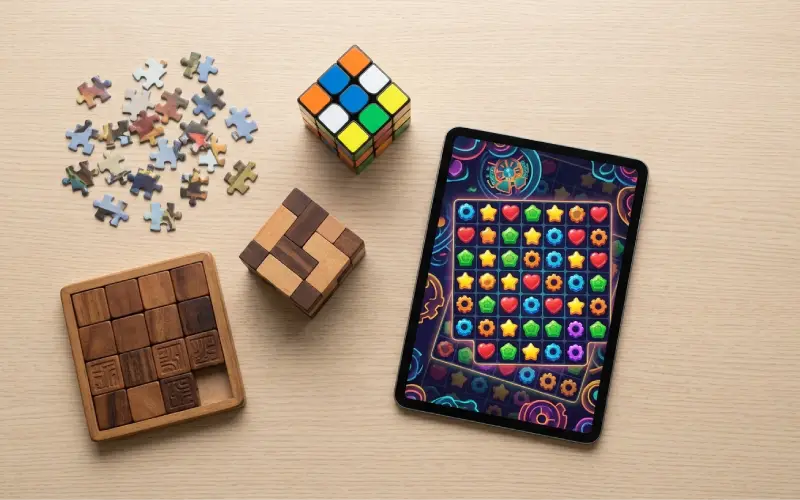
Different genres reward different habits. The puzzle video game family includes several distinct types. Here is how to adjust your approach for the most common ones. Keep the nine core methods above in mind, and treat the tips below as small tweaks on top.
Block-pushing puzzles
Games in the Sokoban style punish careless pushes. A box pushed into a corner usually cannot move again, so one bad push can end the level. Before every push, ask whether you can still reach the box from another side afterward. Spotting that dead end early saves whole restarts.
Physics puzzles
Games like Portal reward patience and momentum. Speed you carry into a portal stays with you when you come out, so the question is often how to build speed, not only where to go. Combine that with strategy seven: change one variable per attempt.
Tile-matching puzzles
Moves near the bottom of the board shake up everything above them. That causes lucky cascades, but it also wrecks any plan you made. So work near the top when you want control. Work near the bottom when you are stuck and want a shake-up.
Adventure and escape-style puzzles
Collect first and combine later. Gather every item and note, then ask what each one could plausibly do. Clicking every item on every hotspot works eventually, but it teaches you nothing. A written list of items and locked things beats random clicking every time.
Programming and automation puzzles
Solve the level badly first. A working, ugly answer beats an elegant idea that never runs. After the level is complete, go back and shrink your solution. That second pass is where much of the fun lives.
Three habits that quietly waste your time
Even good puzzle game strategies fail when old habits sneak back in. Watch for these three.
Clicking at random. Random input feels like progress because things move on screen. However, it rarely teaches you the rule behind the movement.
Repeating the same mistake. If you reset the same way twice, change something else on the third try.
Skipping tutorial text. Tutorials in puzzle games are not filler. They often contain the exact verb the level needs.
A five-minute practice routine
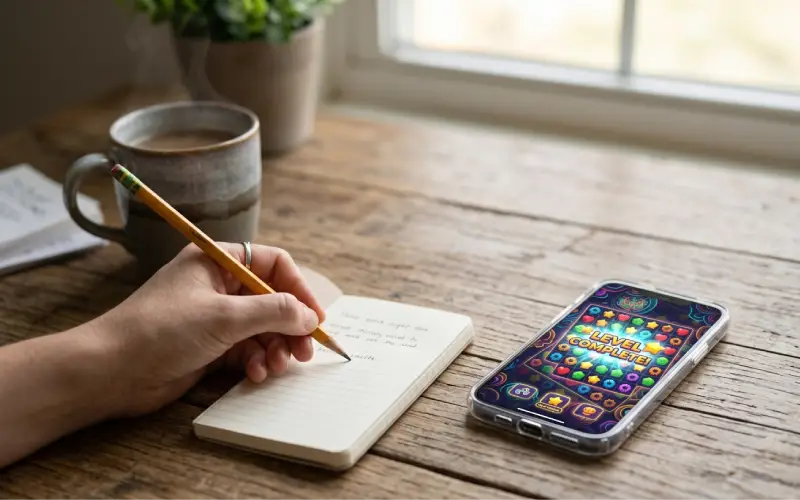
You improve at puzzle games the same way you improve at anything else: by reviewing your work. After each level you solve, spend one minute on a one-line postmortem. Write: “The trick was ___.” Keep it short, like “work backward from the exit” or “the unused tile was the key.”
After ten levels, read your notes. Patterns jump out, and you will see that you reuse the same few tricks again and again. That list becomes your personal set of puzzle game strategies, and it is more useful than any list from a blog.
Then, once a week, replay one level that gave you trouble. If it feels easy now, your habits are working. If it does not, pick a strategy from this guide that you skipped and try that one.
Puzzle game strategies: frequently asked questions
Start with three: name the verbs, spend early moves on testing, and write down your question before you take a break. They work in almost every puzzle game. For game picks that suit new players, see our guide to puzzle games for beginners.
Review your wins. A one-line note after each level builds a personal toolkit, and the notes show you which tricks you already use.
Usually you missed a rule or trusted a false assumption. Recheck the fixed parts of the board, because that is where hidden rules live.
Yes, but in small steps. Use the help ladder from strategy nine so that you keep the satisfying part for yourself.
A good rule is ten minutes without a single new idea. After that, write your question down and step away.
They are good fun and good practice in patience. The evidence that they raise general intelligence is much weaker than advertising suggests, so enjoy them for their own sake.
Yes, because the thinking is identical. Touch puzzles often have cheap undo buttons, which makes them ideal for strategy four.
Final thoughts
Luck matters less in puzzle games than most players think. A handful of repeatable habits beats raw talent, and every habit in this guide takes seconds to use. Pick one strategy, apply it to your next level, and note whether it helped.