

 15 min read
 Updated on October 6, 2026
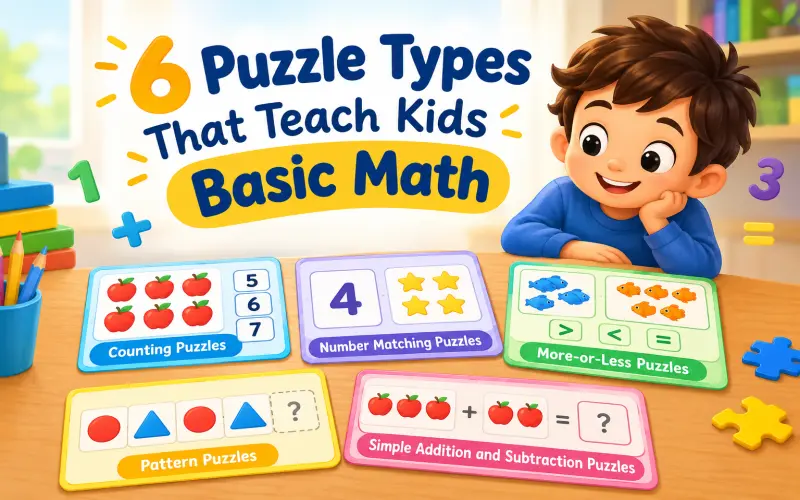
Math doesn’t have to start with worksheets, flashcards, or a lineup of equations. For little ones, math concepts can also emerge organically through play and puzzles. Tallying items, weighing amounts against each other, ordering numbers, spotting patterns, and figuring out basic combinations — these are all pursuits that let children sharpen their early math abilities.
Ask a child to solve twenty sums and you may get a sigh. Put the same arithmetic inside a puzzle and the sigh often becomes “wait i can do that , let me try again.” The skills are identical, but the child feels like a detective instead of a student.
Math is more than just correct answers. It is about seeing how quantities relate with each other, how shapes combine to form one shape, and how patterns grow. A good puzzle lets children explore those ideas without a grade hanging over them. Below are six puzzle types, what each one builds, when children are usually ready for it, and a small challenge to try today.
1. Counting Puzzles
Counting puzzles are often a child’s first step into math, transforming the simple question “how many?” into a tiny adventure. Rather than merely repeating numbers from memory, children search for concealed objects in an illustration, count animals in a farmyard scene, or pair a collection of bananas with the correct number card.
This interactive approach develops one-to-one correspondence—the idea that each object receives a single number as it is counted. It also shows that the final number said represents the total, forming the basis for every future skill, from addition through place value.
Counting activities are most effective with tangible objects like buttons, blocks, or toy vehicles. Have your child count the items, add one extra, and count them again—the concept of “one more” will gradually become intuitive. Ideal for ages 3 to 6, these activities require no reading, create no pressure, and take just a few minutes to leave a lasting impact.
Example: The Hidden Coins Game
You’ll need seven coins and a paper cup.
Line up all seven coins on the table, and have your child touch each one as they count aloud: “1, 2, 3, 4, 5, 6, 7.”
Ask, “How many coins are there?” If your child says “7” without counting again, they understand that the final number tells how many there are altogether.
Next, cover three coins with the cup and ask, “How many can you see?” Let your child count the four coins that remain visible.
Ask, “How many are hiding?” Then raise the cup so your child can check by counting them.
End with, “If I put the hidden coins back, how many coins will we have?”
In under two minutes, your child has practiced counting, early subtraction, and early addition without a single worksheet.
Make it easier or harder:
- Easier: Use only 3 or 4 coins and hide just one.
- Harder: Use 10 coins, hide a different amount each round, and let your child guess the hidden number before lifting the cup.
2. Number Pairing Puzzles
Number matching puzzles are a great way to help kids see how the same number can be shown in different ways.
Once a child can count a small group, the next step is connecting that amount to the written number. Number matching puzzles do exactly this. The child pairs a numeral with a picture of that many items, a numeral with its number word, or two different ways of showing the same quantity, such as five dots and the digit 5.
This teaches that a number is not just a sound but a symbol with a fixed meaning, and that the same amount can look different on the page. Matching also builds quick recognition of digits, which makes later work like reading a clock, a price tag, or a page number feel easier.
Domino-style cards, memory-pair games, and simple cut-and-match puzzles all work well, and they need very little setup. Suitable for ages 4 to 7, these puzzles are especially helpful for children who can count aloud but still mix up written numbers such as 6 and 9.
Example: The Number Pair Cards
You need ten small paper cards, a marker, and a few stickers or a pen for drawing dots.
- On five cards, write the digits 1 to 5, one per card.
- On the other five cards, draw the matching number of stickers or dots: one dot, two dots, and so on.
- Mix all ten cards and lay them face up on the table.
- Ask your child to pick a digit card, say its name, and find the card with the same number of dots.
- Have them touch each dot while counting to check the match, then place the pair side by side.
For example, if your child picks the digit 4, they should find the card with four dots, count “1, 2, 3, 4” to confirm, and move the two cards together. Keep going until all five pairs are made.
Another example is a puzzle might say:
4
and ask the child to match it to:
🍌🍌🍌🍌
Or the child might have to link the number 8 with a picture of eight objects.
The trick here is that the child isn’t just memorising what the number looks like. They are relating the symbol to its quantity.
Why matching works well
Matching gives children a visible relationship.
Instead of asking:
“What is 5?”
the puzzle can show:
5 → 💠💠💠💠💠
The child can see that the symbol represents a particular quantity.
This can make early number concepts more concrete and easier to explore during play.
3. Puzzles About More and Less
After a child learns to count a small group of objects, the next step is connecting that amount with the numeral written on the page. Number-matching puzzles support this skill. The child may pair a numeral with a picture containing the same number of items, match a numeral with its number word, or connect two representations of one quantity, such as five dots with the digit 5.
These activities show that a number is not merely something spoken aloud; it is a symbol with a stable meaning, and the same quantity can be shown in multiple ways. Matching also builds quick numeral recognition, helping future tasks like reading a clock, price tag, or page number feel more manageable.
Example: The Snack Showdown
You need a bowl of raisins, cereal pieces, or small buttons, and two paper plates.
Place a small handful of items on each plate, for example 4 on one and 6 on the other.
Ask your child to line up the items from each plate in two rows, one directly under the other, so every item has a partner.
Look at the rows together and ask,”Which row has extra items left over?” The row that sticks out has more.
Ask,”How many extra are there?” Let your child count the leftover items. In this case the answer is 2, so the second plate has 2 more.
Finally, ask,”What can we do to make both plates equal?” Your child might move 1 item from the bigger plate to the smaller one, so each plate holds 5.
In just a few minutes, your child has practiced comparing, finding a difference, and the idea of making things fair, which is the early seed of balancing and equal sharing.
Make it easier or harder:
- Simpler: Contrast greatly different quantities, such as 2 and 7, where the result is obvious to observe immediately.
- More challenging: Apply similar amounts like 8 and 9, introduce a third plate and inquire which contains the most, or encourage the child to anticipate the victor before arranging the objects in order.
4. Number Pattern Puzzles
After children learn to count, identify numerals, and compare groups, they can practice the order numbers follow. They might fill a gap, sort mixed-up number cards, or finish a row such as 11, 12, 13, __.
These activities help children form a mental number line, so they know what comes before or after a number and how numbers relate in distance. This understanding supports counting on, skip counting, addition, subtraction, and place value. Puzzles also sharpen attention: a number in the wrong spot disrupts the sequence. Many children enjoy spotting the missing number, like finding a clue. The puzzles work well for ages 4 to 8, based on the number range, and require only paper and a pen.
Example: The Hopping Number Path
You need a roll of masking tape or chalk outdoors 10 sticky notes and a marker
Stick the tape on the floor in a straight line and place 10 sticky notes along it numbered 1 to 10 in order. Ask your child to hop from 1 to 10 saying each number aloud as they land. Have your child close their eyes then remove two notes for example 4 and 7
Ask them to hop along the path again and stop at each gap They must work out which numbers are missing and say them before you return the notes. Check the answer by placing the notes back and hopping the full path together
If your child stops at the first gap and says, “This is after 3 and before 5, so it must be 4,” they are using sequence reasoning, not just memory.
Make it easier or harder:
- Simpler: Remove only one note, and use numbers 1 to 5.
- More Challenging: Extend the path to 20 or beyond, remove three or four notes, or start from a different number such as 8 and count up to 18. You can also try hopping backward from 10 to 1.
5. Simple Addition and Subtraction Puzzles
After children are comfortable with counting and quantities, puzzles can introduce very small addition and subtraction problems. But instead of showing a bare sum like 3 + 2 = ?, a good puzzle turns the same idea into a visual challenge. The child sees a group of objects, watches something change, and works out the new total.
This matters because it lets children discover what adding and subtracting actually mean before they memorize any facts: adding is joining groups together, and subtracting is taking some away.
The answer feels like something to find, not something to recite. These puzzles suit ages 5 to 8, and keeping the numbers within 10 is plenty at the start.
Example: The Banana Puzzle
Imagine a puzzle that shows three bananas:
🍌🍌🍌
Then two more bananas appear:
🍌🍌
The puzzle asks: “How many bananas are there now?”
The child counts all the bananas together: 1, 2, 3, 4, 5. There are five. Without writing a single number sentence, they have just solved 3 + 2.
The same idea works in reverse. The puzzle now shows five bananas:
🍌🍌🍌🍌🍌
Then two disappear, perhaps eaten or picked up by someone else. The puzzle asks: “How many bananas are left?”
The child counts what remains: 1, 2, 3. There are three. They have just solved 5 − 2, and they may notice that they are back to where they started.
You can play this at the table with real fruit, toy bananas, red buttons, or a drawing. Use your hand or a paper cup to hide the “disappearing” bananas, so the child must think about what is gone instead of just seeing it.
Make it easier or harder:
- Easier: Start with 1 or 2 bananas and add or remove just one. Let your child touch each banana while counting.
- Harder: Show 8 bananas, take away 3, then add 2 more, and ask for the final total. You can also hide the result and ask a missing-number question, such as “I had 4 bananas, now I have 7. How many came?”
A tip for parents: After a few turns, write the number sentence beside the picture, such as 3 + 2 = 5, so your child can see the link between the pictures and numbers. Then explain that the two puzzles are connected: since 3 + 2 = 5, subtracting 2 from 5 takes you back to 3. Understanding addition and subtraction as opposites makes them feel less like separate rules to memorize.
6. Shape Puzzles
Mathematics is not concerned only with counting and working with numbers. It also includes understanding the shapes and forms that appear all around us, and shape puzzles are often one of the first ways children begin exploring this part of mathematics.
In a shape puzzle, a child may recognize, compare, group, or arrange familiar shapes such as circles, squares, triangles, and rectangles. For example, the child might match a block to the outline with the same shape or create a picture by putting together several separate pieces that have been cut out.
This activity helps children develop the habit of examining a shape carefully and noticing its specific characteristics, such as how many sides it contains, whether its corners are sharp and pointed or soft and rounded, and whether its edges are straight lines or curved ones. Building this kind of visual-awareness skill provides a useful foundation for learning geometry later on.
It also supports early reading, writing, and drawing development, since letters and numbers are constructed from many of the same basic lines, angles, and curves. These puzzles are generally well suited to children between the ages of 3 and 7, and most can be completed with only a few simple materials, including paper, scissors, and everyday objects found around the home.
Example: Build a House
Imagine a puzzle that shows the outline of a simple house:
🔺 on top for the roof
⬜ in the middle for the walls
🟫 in the center for the door
You will need colored paper, scissors, and a sheet of plain paper for the base.
- Cut out one large square, one triangle, one small rectangle, and two small squares from colored paper.
- Ask your child to name each shape and say how they know. They might say, “The triangle has three corners,” or “The square has four sides that are the same.”
- Show the puzzle picture and ask, “Which shape do you think is the roof?” Let your child try the triangle on top of the square and decide whether it fits.
- Have your child place the rectangle as the door and the small squares as windows, then glue everything down.
- Finish with a counting question that links back to earlier skills: “How many shapes did we use altogether? How many of them have four sides?”
By the end, your child has named shapes, compared their features, and counted and sorted them, all while making a picture they are proud of.
Make it easier or harder:
- Simpler: Use only a square and a triangle, and let your child match them onto a printed outline.
- More Challenging: Remove the outline and give a description instead, such as “Build a boat using one rectangle and two triangles,” or ask your child to invent a picture and tell you which shapes it contains.
A tip for parents: Turn the puzzle into a shape hunt around your home. Ask, “Can you find something shaped like a circle?” A plate, a clock, or a coin all count. Seeing shapes in everyday objects shows children that math is part of the real world, not only something that lives on a page.
Frequently Asked Questions About Math Puzzles for Kids
Most children are usually ready for simple counting activities and basic matching puzzles at around 3 to 4 years old. Puzzles involving addition, subtraction, or identifying and using different shapes are generally better suited to children between about 5 and 8.
However, each child develops skills at their own pace, so choose a puzzle that provides a manageable, gentle challenge without being so difficult that it becomes frustrating or overwhelming.
For most young children, a brief session of around ten to fifteen minutes is usually sufficient. Keeping activities short helps maintain their attention and enthusiasm, while ending before they become tired or bored leaves them wanting to come back and try again next time.
Not at all. Each example in this guide uses common household items you likely already have, such as buttons, paper, snacks, and toy cars. Store-bought sets may provide additional variety, but they are not necessary.
Start with counting puzzles, then move through number matching, comparing, number order, addition and subtraction, and finally shapes. The order builds from simple to more advanced, but children can enjoy shape puzzles at any stage, so follow their interest.
Wait a moment first. Ask a question like “Can you count them once more?” so your child can find the error on their own. Spotting a mistake alone builds more confidence than being told the answer.
Both have value. Physical objects help young children understand quantities by touch, while on-screen games offer variety and instant feedback. A mix works well, as long as screen time stays reasonable and an adult stays involved.
Final Thoughts
Math feels quite different to a child when it is presented as a puzzle to solve rather than a task to complete. Counting, matching, comparing, ordering, adding, and constructing with shapes each contribute a small piece to a solid foundation, and all can begin with objects already available at home. Keep sessions brief, ask questions rather than provide answers, and allow your child to take the lead.
If you want to see how puzzles help the brain beyond math, read our guide on what puzzles do to the brain, and for more ideas on early math learning, you can explore the free resources from NAEYC (National Association for the Education of Young Children). When you’re ready for more variety, try the free puzzle games on GamesDesert.