

 12 min read
 Updated on October 5, 2026
Learning how to solve jigsaw puzzles with no fixed piece positions requires a slightly different approach from traditional puzzles. Jigsaw puzzles are usually associated with finding a piece and placing it into one specific location. Digital puzzles can work differently. Instead of giving every piece a predetermined position, some games allow you to move pieces freely around the play area and connect them wherever matching edges meet.
This changes the way you should approach the puzzle.
When there are no fixed positions, you are not simply searching for a particular empty slot. You are looking for connections. A piece may belong to another piece somewhere on the board, and once the two are connected, the resulting group becomes a new clue for finding the next piece.
This guide explains how to solve this type of jigsaw puzzle more efficiently, especially when the pieces begin scattered around the screen.
What Does “No Fixed Piece Positions” Mean?
In a traditional digital jigsaw puzzle, a piece may have a specific location on the board. You might drag it toward that location, and the game can help you determine whether it is correct.
A free-position puzzle works differently.
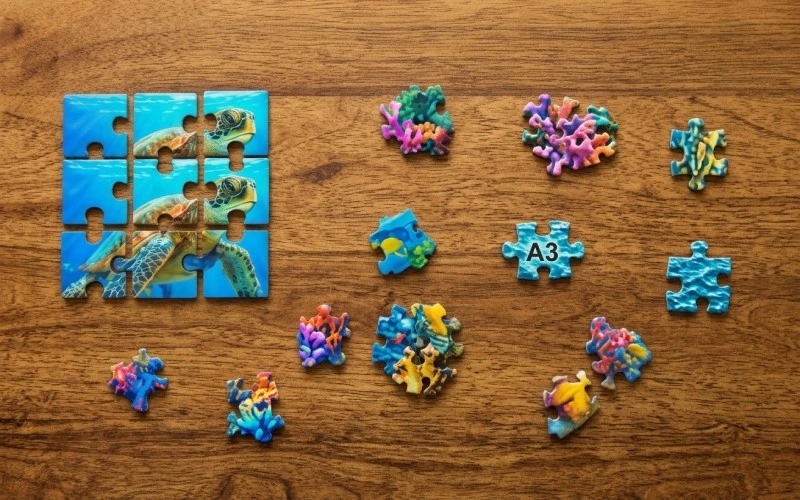
The pieces can be moved around the playing area without being assigned to a specific location. You can pick up one piece, move it beside another piece, and test whether their shapes and images match.
There are two main things we need to consider:
- What does the piece looking like?
- Which other piece we can connect to it?
The second question becomes especially important when the pieces are randomly scattered.
Instead of solving the puzzle by filling predetermined spaces, you are gradually building connected groups until the complete image is formed.
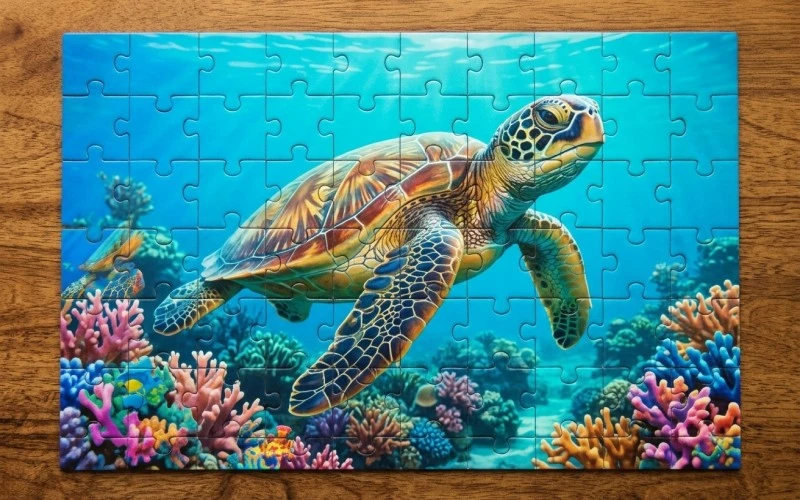
1. Look at the Complete Picture First
Before moving pieces around, take a moment to study the complete image.
Look for major visual areas such as:
- Large areas of blue sky
- Water
- Green plants
- Buildings
- Animals
- Faces
- Text
- Strong lines
- Bright colors
- Distinctive patterns
You don’t need to memorize every detail.
The purpose is to create a general mental map of the image.
For example, if the puzzle contains an ocean animal surrounded by blue water, you already know that pieces containing parts of the animal are likely to form one recognizable section, while pieces showing mostly blue water may belong around it.
This gives you a starting point before you begin testing connections.
2. Don’t Try to Find the Final Position of Every Piece
This is one of the biggest differences between fixed-position and free-position puzzles.The key to how to solve jigsaw puzzles with no fixed piece positions is to build connections gradually instead of trying to place every piece immediately.
If the game does not assign pieces to specific slots, don’t spend your time asking:
“Where exactly does this piece go?”
Instead ask:
“Which piece can connect to this piece?”
This small change in thinking can make the puzzle much easier.
Suppose you have a piece showing part of an animal’s eye. You may not know its exact position on the complete image yet. But you may recognize another piece showing the animal’s nose or surrounding fur.
Connect those pieces first.
Once several pieces form a group, their position in the overall image becomes much easier to understand.
3. Start With the Most Recognizable Pieces
Not every piece gives you the same amount of information.
Some pieces contain very recognizable details. Others may be mostly one color.
For example, a piece containing:
- An animal’s eye
- A distinctive stripe
- Part of a letter
- A strong color boundary
- A unique object
- A clear line
can be much easier to match than a piece containing nothing but blue water.
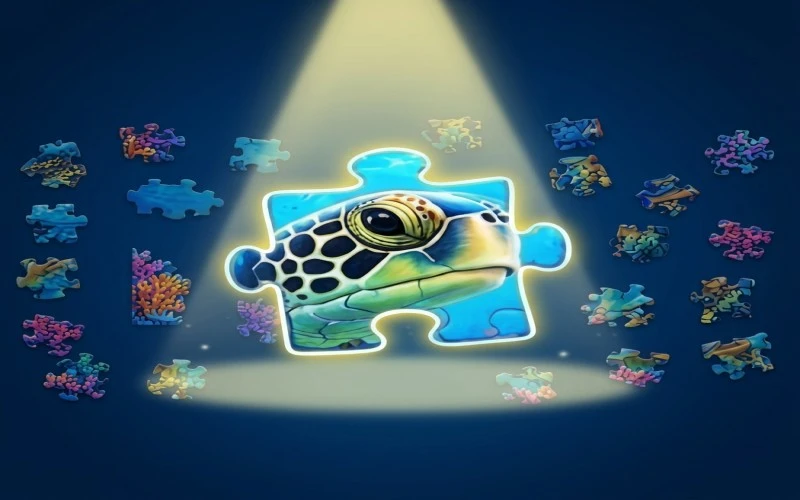
Start with the pieces that provide the strongest visual clues.
These pieces can become anchor pieces for your puzzle.
Once you find another piece that connects to an anchor, you can continue expanding that small group.
4. Build Small Groups Instead of Solving the Whole Picture at Once
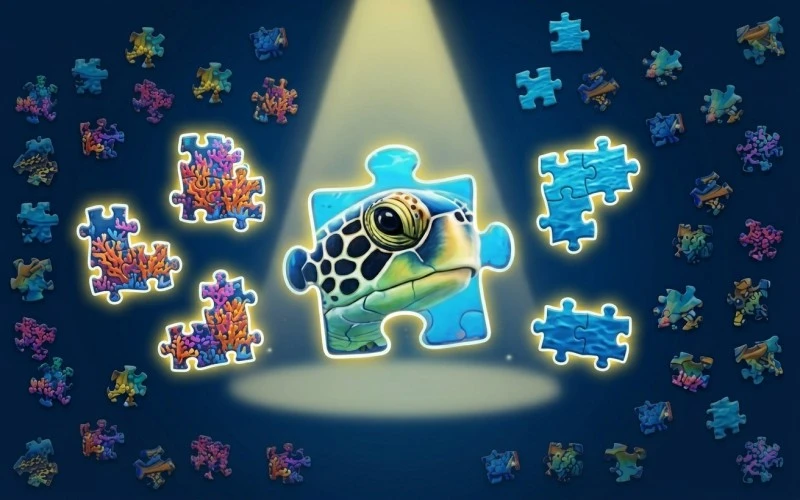
When pieces have no fixed positions, you don’t necessarily have to construct the puzzle from one side to the other.
Instead, build small connected groups.
For example:
Piece A → Piece B → Piece C
Then separately:
Piece D → Piece E
And later:
ABC → DE
This approach reduces the amount of information you have to process at one time.
Imagine that you have 40 loose pieces on the screen. Searching through all 40 pieces for every connection can become tiring.
But if you have already created a group of five connected pieces, you only need to search for pieces that continue the image around that group.
The puzzle gradually becomes more organized as you play.
5. Use Color as a First-Level Filter
Color can quickly reduce the number of pieces you need to consider.
Suppose the piece you are holding contains mostly:
- Blue
- Green
- Yellow
- Red
- Brown
Start by looking for pieces that contain compatible colors.
This doesn’t mean two pieces with the same color necessarily connect.
It simply gives you a smaller group of candidates.
For example, if you are working on a blue ocean section, you can temporarily ignore pieces that clearly belong to a red or green part of the image.
Once the puzzle becomes more complete, you can use finer details such as patterns, lines and piece shapes.
6. Look at the Image Pattern, Not Just the Color
Color alone is often not enough.
Several pieces can have almost identical colors while showing completely different parts of the image.
Pay attention to:
- Lines
- Curves
- Texture
- Shadows
- Color transitions
- Object boundaries
- Repeated patterns
Imagine a piece containing a curved black line.
The best match may not be another piece with the same color. Instead, it may be the piece that continues that exact line.
This is particularly useful for animal outlines, buildings, tree branches, waves and other objects with recognizable shapes.
7. Learn to Read the Shape of Each Piece
When visual information becomes less obvious, the physical shape of the pieces becomes an important clue.
Look at each side of the piece.
A side may have:
- A protruding tab
- An inward indentation
- A relatively straight edge
- A curved shape
When two pieces connect, their sides need to complement each other.
For example, a protruding section needs a corresponding indentation on the neighboring piece.
This becomes particularly useful when you reach large areas with similar colors.
If several pieces all look like different shades of blue, their shapes can help narrow down the possible matches.
8. Rotate Pieces When Necessary
Some puzzle games allow pieces to be rotated.
If rotation is available, don’t assume that a piece’s current orientation is its final orientation.
A visually promising match may appear incorrect simply because one piece is facing the wrong direction.
Try rotating it and comparing the sides again.
However, don’t rotate pieces randomly for every possible match. First use the image, color and shape to identify likely candidates, then test the orientation.
This keeps the solving process more systematic.
9. Use Connected Groups as New Clues
One of the biggest advantages of a free-position puzzle is that every successful connection gives you more information.
Imagine that you have connected four pieces.
Now you can study the outside edges of that four-piece group.
You may notice:
- A continuation of a blue area
- A missing part of an animal
- A line that clearly continues
- A color transition
- A recognizable object
That new information can help you find the next piece.
This creates a useful cycle:
Find a match → build a group → study the group → find the next match → expand the group.
The more complete the group becomes, the easier it can be to identify what belongs next to it.
10. Don’t Force a Piece That Almost Fits
A common mistake is trying to make two pieces connect simply because their colors appear similar.
If the shapes don’t properly match, move on.
A good connection should make sense from multiple clues:
- The image continues naturally.
- The piece shapes complement each other.
- The colors or patterns align.
- The connection doesn’t create an obvious visual break.
If only one clue matches while everything else looks wrong, the pieces probably don’t belong together.
Moving on can save more time than repeatedly testing the same incorrect combination.
11. Save Similar Pieces for Later
Large areas with almost identical colors can be difficult.
For example:
- Open blue water
- Clear sky
- Sand
- Snow
- Plain walls
- Dark backgrounds
These areas often provide fewer visual clues.
Instead of spending a long time trying to solve them immediately, work on the distinctive sections first.
Once you have connected the recognizable parts of the image, the number of remaining pieces becomes smaller.
At that point, the difficult pieces are easier to analyze because there are fewer possibilities.
12. Use Empty Spaces as Clues
As your puzzle becomes more complete, don’t only look at the loose pieces.
Look at the gaps between the connected pieces.
An empty space can tell you a lot.
You can examine:
- The shape of the missing sides
- The color that should continue
- The direction of a line
- The surrounding image
- The number of possible pieces that could fit
This is especially useful near the end of the puzzle.
When only a few pieces remain, the question changes from:
“Where could this piece go?”
to:
“Which remaining piece matches this exact opening?”
That is a much smaller problem.
13. Keep Your Workspace Organized
Randomly scattered pieces can quickly become difficult to manage, especially on a screen.
If the game allows you to move pieces freely, try to keep loose pieces in one general area and connected groups in another.
For example:
Left side: loose pieces
Center: active puzzle group
Right side: pieces you are currently comparing
You don’t need a complicated system.
The goal is simply to prevent the workspace from becoming another puzzle.
Good organization also makes it easier to scan the remaining pieces when you’re searching for a particular color or shape.
14. Change Your Strategy When You Get Stuck
If you have been trying to solve the same area for several minutes without progress, continuing to repeat the same search may not help.
Change what you’re looking for.
If you were using color, try shape.
If you were matching shapes, look at the image pattern.
If you were working on a difficult area, switch to a recognizable section.
You can also step away for a short break and return with a fresh view of the puzzle.
Sometimes the piece you couldn’t identify before becomes obvious once you stop staring at the same group.
A Simple Strategy You Can Follow
If you’re new to free-position jigsaw puzzles, use this sequence:
Step 1: Study the completed image
Identify the main colors, objects and patterns.
Step 2: Find recognizable pieces
Look for faces, animals, text, strong lines or unusual colors.
Step 3: Create your first small group
Connect pieces that clearly belong together.
Step 4: Expand the group
Search for pieces that continue its colors, patterns and shapes.
Step 5: Start another group if necessary
Don’t force everything into one group immediately.
Step 6: Use piece shapes
When colors become less useful, compare tabs, gaps and edges.
Step 7: Leave difficult areas for later
Large uniform areas are usually easier after the rest of the image is assembled.
Step 8: Use the remaining gaps
Near completion, let the shape and surrounding image tell you what belongs there.
Step 9: Connect the final groups
Once most sections are complete, bring the groups together to form the finished image.
Common Mistakes to Avoid
Trying to place every piece immediately
You don’t need to solve every piece as soon as you see it. Build confidence around the pieces that give you strong clues.
Searching randomly
Moving from one random piece to another can waste time. Narrow your search using color, pattern and shape.
Ignoring piece orientation
If rotation is available, check whether a promising piece needs to be turned.
Spending too long on one difficult section
Move to another section and return later.
Matching by color alone
Similar colors don’t guarantee a connection. Look for the continuation of the actual image.
Forcing pieces together
If a connection doesn’t make visual and physical sense, don’t force it.
Why Free-Position Puzzles Require a Different Mindset
A puzzle with fixed positions can feel like a placement problem:
Find the piece → find its slot → place it.
A free-position puzzle is more like a connection problem:
Find a clue → find a matching piece → create a group → use the new group as another clue.
That difference is what makes this style of puzzle interesting.
You are not only identifying individual pieces. You’re gradually discovering relationships between them.
Final Thoughts
Solving a jigsaw puzzle without fixed piece positions is mainly about reducing the number of possibilities.
Start with recognizable visual clues, build small groups, compare colors and patterns, and use piece shapes when the picture becomes less helpful. As each group grows, it provides new information that helps you find the next connection.
You don’t have to know where every piece belongs from the beginning.
Build one connection at a time, and let the completed sections guide the rest of the puzzle.
Ready to try these techniques yourself? Put your jigsaw-solving skills to the test with our Ocean Animals Jigsaw Puzzle, where you can connect scattered pieces and build a beautiful underwater scene step by step.
Want a bigger challenge? If you’re ready to move beyond smaller puzzles and try more challenging online jigsaw puzzles, you can explore the collection at Jigsaw Explorer and choose a puzzle that matches your preferred difficulty.