

 10 min read
 Updated on October 5, 2026
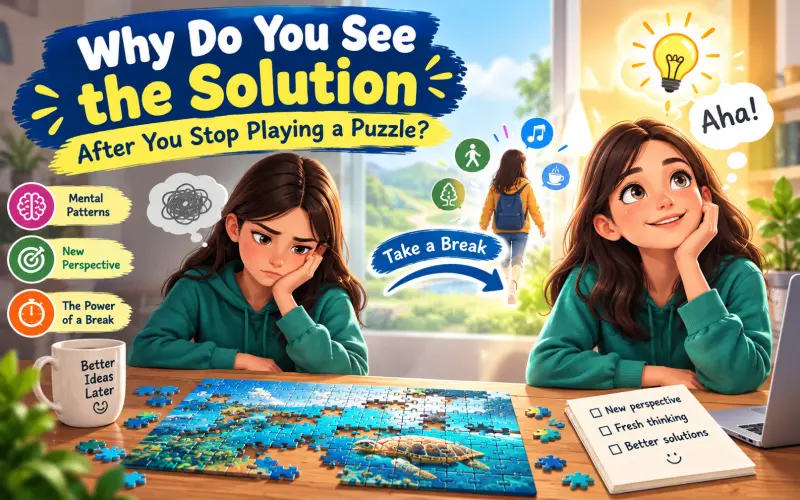
Have you ever spent several minutes staring at a puzzle without making any progress?
You stare at a crossword clue for twenty minutes and get nowhere. You give up, wash the dishes, and the answer drops into your head halfway through the second plate. This happens to almost every puzzler, and it feels like a small piece of magic. So why do you see the solution after you stop playing a puzzle?
The answer is a mix of psychology, memory, and the way your brain handles problems when you are not forcing it. Researchers have studied this for decades and still debate some of the details, so this article separates the well-supported ideas from the guesses. It is a general-interest guide, not medical or scientific advice.
It Has a Name: The Incubation Effect
Psychologists call this experience the incubation effect. The term describes the finding that people often solve a hard problem better after a break than after continuous effort. The idea goes back to early writers on creativity, who described stages of preparing, stepping away, and then suddenly seeing the answer.
Laboratory studies have tested it with word puzzles, riddles, and creative tasks. Many found that people who took a break did better than those who kept working, although results vary with the type of problem and the kind of break. The effect is real but not guaranteed, which is why the sections below look at the reasons behind it.
Reason 1: You Were Stuck in a Mental Rut
When you first look at a puzzle, your brain picks an approach and commits to it. This is usually efficient, but it becomes a trap when the approach is wrong. Psychologists call it fixation or a mental set. You keep trying variations of the same idea, and every attempt fails for the same hidden reason.
A classic example is a riddle where the word “bat” could mean an animal or a piece of sports equipment. If your mind locks onto one meaning, you can read the clue ten times without noticing the other. Effort does not help, because you are pushing harder in the wrong direction. A break gives the rut a chance to loosen.
Reason 2: The Wrong Ideas Fade
One of the leading explanations is surprisingly simple: you forget your failed attempts. While you are working, the same wrong answers keep coming to mind because they are strongly activated. They crowd out less obvious options.
Once you stop, that activation weakens over time. When you return, the dead-end ideas are less loud, and a different possibility finally has room to appear. This explanation is sometimes called the forgetting hypothesis. It also explains why a break that is too short may not help, since the wrong ideas have not faded yet.
Reason 3: Your Mind Keeps Working in the Background
Another idea is that your brain continues processing the problem while your attention is elsewhere. When you are not focused on a task, a network of brain regions known as the default mode network tends to become more active. This network is linked to mind-wandering, imagining, and connecting memories.
Some researchers think this background activity lets distant pieces of knowledge link up in ways that focused effort does not. It is important to be careful here. The idea of “unconscious thinking” is popular, but scientists still disagree about how much real problem-solving happens without awareness. A fair summary is that the brain does not switch off, and wandering thought may help ideas combine.
Reason 4: The World Hands You Clues
Sometimes the answer comes because something in your surroundings nudges it loose. You might see a word on a sign, hear a phrase on the radio, or notice the shape of a cup, and suddenly it links to the problem you left behind. This is sometimes called opportunistic assimilation.
The reason it works is that an unsolved problem leaves your mind slightly “primed.” Details related to it stand out more than they otherwise would. Without that priming, you would walk past the same clue without noticing. So part of the break effect is that you meet fresh information while your mind is still lightly tuned to the puzzle.
Reason 5: Sleep Helps Reorganise What You Learned
If you leave a puzzle overnight and solve it in the morning, sleep may deserve some credit. During sleep, the brain replays and organises recent experiences, a process called memory consolidation. Studies have found that people sometimes spot hidden patterns or rules more often after a night of sleep than after the same time spent awake.
Researchers do not fully agree on how this works, and sleep is not a magic solver. But it clearly helps in other ways: a rested brain pays attention better, handles frustration better, and is less likely to repeat the same mistake. If a puzzle has beaten you at midnight, going to bed is often a better strategy than staying up.
Reason 6: Unfinished Business Stays on Your Mind
You may have noticed that an unsolved puzzle nags at you. Psychologists link this to the Zeigarnik effect, the observation that unfinished tasks tend to stay more active in memory than finished ones. The original studies were done in the 1920s, and later research has had mixed results, so it is best viewed as a tendency, not a law.
For puzzlers, the effect may explain why the problem keeps resurfacing in quiet moments. Each time it pops up, you look at it from a slightly different mental state, and each of those glances is another chance for the answer to appear. The puzzle never really leaves, even when you think you have stopped.
Reason 7: Pressure Narrows Your Thinking
Frustration is not a neutral state. When you feel pressured or annoyed, your attention tends to narrow, almost like tunnel vision. That is useful when you need to focus on a threat, but it is a poor condition for flexible, creative thinking, which is what a stuck puzzle usually needs.
Stepping away lowers the pressure. With a calmer mind, you consider more options, including unusual ones. Research on mood and problem-solving suggests that relaxed or mildly positive states can help people make remote connections. This is one reason a walk, a shower, or a cup of tea can be so effective. You are not only waiting, you are changing the mental conditions that were blocking you.
Reason 8: You Return With Fresh Eyes
When you stare at the same grid or picture for a long time, your perception adapts. You stop noticing details because your brain treats the unchanging scene as background. A jigsaw piece you looked past a dozen times becomes invisible.
A break resets this. When you come back, the grid looks new again, and small details stand out. Changing your view physically can add to the effect: turn the puzzle around, stand up and look from a distance, or rewrite the clues on a fresh page. Many solvers find that a different angle does what hours of staring could not.
Reason 9: The Type of Break Matters
Not every break is equal. Some studies suggest that a light, undemanding activity, such as a simple chore or a quiet walk, can work better for incubation than a mentally demanding one, because it leaves room for your mind to wander. Other studies find that the benefit depends on the problem, so the research is not settled.
Scrolling through a busy feed or reading a complicated article may fill your mind with new information and leave little space for background connections. A gentler activity lets thoughts drift. If you want to use a break well, choose something calm and repetitive, and try not to force yourself to think about the puzzle.
What a Break Cannot Do
It is worth being realistic. A break does not solve a puzzle by itself. If you lack a key piece of knowledge, such as a word you have never learned or a technique you have never seen, no amount of resting will produce the answer. The incubation effect helps most when you already have what you need but are looking at it the wrong way.
Breaks can also become avoidance. If you quit every time a puzzle gets difficult, you never build the skill of working through frustration. The best approach is to try seriously first, then rest, then return.
How to Use This When You Are Stuck
Give it a real try first:
Work on the problem until you have genuinely run out of ideas. Rest helps most after honest effort.
Take a break of ten to thirty minutes:
Shorter pauses may not let wrong ideas fade, while very long ones may let you lose track of what you tried.
Choose a gentle activity:
A walk, a shower, or a simple chore leaves your mind free to wander.
Write down where you stopped:
A short note about your failed ideas stops you from repeating them later.
Sleep on very hard problems:
If it is late, rest and return the next day.
Change your view when you return:
Rotate the page, redraw the grid, or explain the puzzle aloud to someone else.
Keep a pen nearby
Ideas that appear during a break can disappear quickly, so jot them down.
For a gentle place to practise this skill, see our guide to jigsaw puzzle benefits. If you want a tougher test, try one of the puzzles from our hardest logic puzzles list.
Frequently Asked Questions
Several things likely combine: wrong ideas fade, your mind loosens its fixed approach, background thought links distant memories, and a random cue in your surroundings may trigger the connection.
It is the finding that people often solve difficult problems better after a break than after continuous work. It is well documented, though its size and causes are still debated.
There is no exact rule. Ten to thirty minutes helps many people, and an overnight rest suits very hard puzzles.
Sleep supports memory consolidation and attention, and some studies show better pattern discovery after sleep. It does not guarantee a solution, but it improves your chances.
Try seriously first. When you notice you are repeating the same ideas or feeling tense, a break is usually the better choice.
Yes. If you lack the needed knowledge, or if the break is too short or too mentally busy, you may return to the same wall.
Final Thoughts
So, why do you see the solution after you stop playing a puzzle? Because stopping changes the conditions of your thinking. Your fixed approach loosens, failed ideas fade, pressure drops, your eyes reset, and your mind keeps quietly turning the problem over. The result feels like magic, but it is mostly your brain doing what it does best when you stop forcing it.
Next time a puzzle defeats you, try giving it an honest effort, then walk away on purpose. When the answer arrives in the middle of a chore, you will know exactly what happened. Has a solution ever come to you in an unexpected place? Tell me in the comments!