

 11 min read
 Updated on October 9, 2026
Most advice about beginner puzzle games is a list of ten titles with a line of praise each. I don’t find that very useful. It does not matter which game one chooses as long as it fits his or her thinking style, and even a perfect puzzle may scare away an inexperienced player if it is not suitable.
In my opinion, another strength of this type of games is the opportunity to deal with them in a different way. Some gamers like to match images, some connect items, find hidden items, solve math problems, or get a ball to the target point.
For those who do not have much experience in dealing with puzzle games, the selection of the proper type is crucial. The game may become frustrating if it is too complicated for a beginner, whereas an interesting one will motivate a person to play more games.
Here is my approach to starting puzzle playing: what should a beginner puzzle be, how to choose a puzzle according to personal features, how to cope with the first difficult week, and how to determine the right moment to advance.
Qualities of a Beginner-Friendly Puzzle
When I evaluate a beginner-level puzzle game, there are five criteria that it has to meet. In case it fails more than two, I will avoid choosing it as my first puzzle.
Brevity of rules. When I cannot formulate the game rules in two phrases, then this puzzle is not a good starter.
Short time rounds. A round lasting from two to five minutes allows getting lots of experience instead of just one attempt.
Progress. It is possible to see the process of improvement during playing, for example, filling squares or using fewer pieces or cards left.
Tolerance of errors. The undo feature or a possibility to start the puzzle again makes players try without fear of failure.
Levels of difficulty. One and the same puzzle should have easy, medium and hard levels.
Start With Your Thinking Style, Not the Game’s Fame
People generally begin with the well-known puzzle, find it uninteresting, and conclude that they don’t enjoy puzzles. I prefer that the puzzle fits the individual. This is my approach.
| If you enjoy… | Start with… | Why it fits |
| Seeing a picture come together | Jigsaw puzzles | You work by sight and color, with no rules to memorize |
| Quiet, step-by-step reasoning | Logic grids and Sudoku-style games | Every move follows from the clues |
| Quick, light fun | Casual match and tile games | Rounds are short and forgiving |
| Words and language | Word-search or word-guessing games | You use vocabulary you already have |
| Remembering things | Matching and pairs games | Success comes from attention more than skill |
| Noticing details | Hidden object scenes | You scan, spot, and tick items off |
Five Types of Starter Puzzle Games I Would Recommend Playing
1. Jigsaw Puzzles
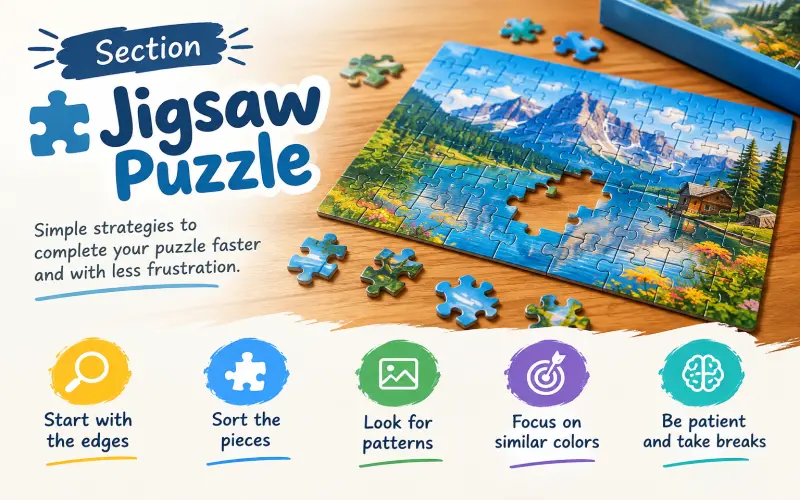
A jigsaw is the most straightforward puzzle game available. No tricks are involved, and time plays no part in the process, except what you decide to set for yourself. Start with something small, 24 to 60 pieces on screen, and use an image with defined color areas – a sunset, garden or a vibrant street scene will do. Don’t try anything with just a blue sky or a plain field of grass as beginners quickly give up with those.
2. Number-Grid Puzzles
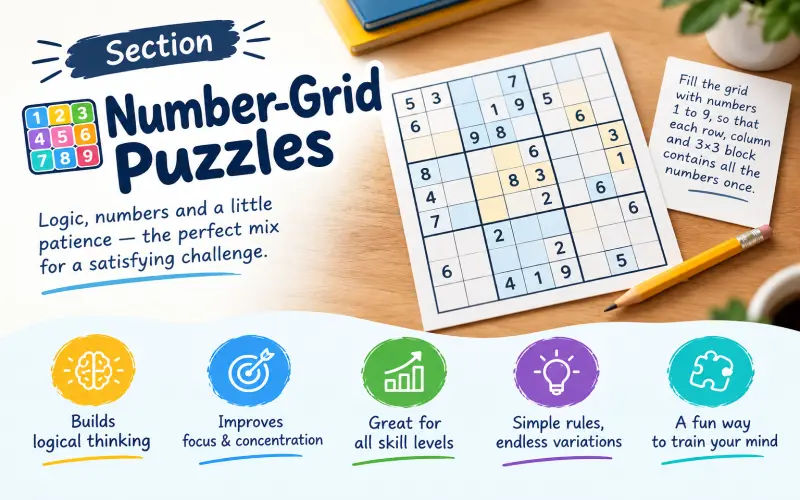
These are games based on filling grids where you have to avoid repeating numbers. The problem with these games is that the rules are simple, and the difficult levels are tough. Play “easy” level until you feel you are too proud. You will find at least one square with just one correct move on any easy board.
3. Memory Matching Games
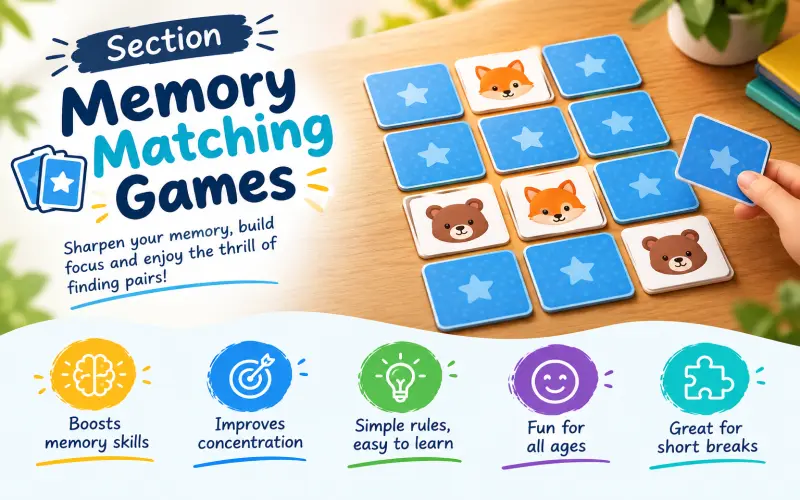
The memory matching games are among the easiest types of puzzles to understand. Most times, there is a grid of cards that are lying face down. You turn them around two by two and try to match them according to the picture. If the pictures do not match, you should make an effort to remember where the cards lie in order to make your attempt again.
There are easy to understand rules, but the puzzle gets more challenging depending on the number of cards present.
Why Beginners Might Like Them
There are no advanced controls and rules to know. The main difficulty is in the observation of pictures and memorizing where you saw them.This type of puzzle appeals to me because of the beginners who want to start with short puzzles. They can begin with a smaller board and then go on to bigger ones.
4. Casual Match & Tile Games
Match neighbors in order to make colors in line or get rid of pairs in a stack. They’re easy to learn and easy to quit playing. I enjoy them as a starter, since you can spend just three minutes on them and still consider your effort productive.
5. Logic Puzzles
In logic puzzles, you get a list of clues and must deduce what follows from it. Logic problems may appear scary at first glance, but simple logic puzzles will simply require crossing out. Choose the smallest grid possible; even a tiny logic problem can be a better teacher than a large one.
How I Intend to Begin
Rather than having a strict schedule, I would have a pattern.
10 to 15 minutes’ session. Lengthy sessions in the early days would always leave me with sleepy eyes and bad moods.
Playing one type of game. Changing games so quickly implies that one would not see any improvement.
Stop after winning. Finish playing a session only when you have played a level you were able to solve.
This would encourage you to come again.
Use hints. A hint is nothing but a good instructor. After getting a hint, one should find out what this hint found but one could not.
Keep loose notes. A single sentence like “first scan edges” or “play a row at once” would make things an everyday routine.
The Frustration Wall (and How to Get Beyond It)
Everyone experiences a time during the third and fourth days when the easy puzzle becomes hard to move forward in solving it. It’s okay because it just means that you have reached the limit of what your initial ideas could solve, and now you need a strategy.
And here is what I do if it happens to me:
Take a step back for a minute; sometimes it will be the answer that comes to you once you return.
Alter your focus. If you were searching for a row, search the column instead.
Speak it aloud. It helps to figure out what part you don’t understand.
Revert to an easier level. This is not a defeat, but a step toward momentum-building.
Set a stopping point before starting. “Another five minutes and then a rest.”
Common Errors That Newbie Puzzle Solvers Commit
Setting the bar too high. Selecting a medium level puzzle board in an attempt to appear competent will cause you to quit immediately. Choose the level where your chances of winning are highest.
Considering hints cheating. Since this puzzle is intended to be a game, there is no scorekeeping involved. Take them whenever you need help.
Solving puzzles when fatigued. Puzzles become more difficult than usual when attempted after a long day. The same puzzle becomes very easy when solved by a refreshed mind.
Competing with other players’ times. The times on display were achieved by individuals who have been playing that puzzle for several years. Compete against your old self.
Consistently solving similar puzzles. Once you find one puzzle that you are comfortable with, you should consider a neighboring puzzle.
Signals That It Is Time To Step Up
There is no need for any test here. Watch out for these indicators:
You go through most of the rounds without a sign.
You can teach your technique to another person.
You feel slightly bored at the current level.
You have started recognizing the patterns unconsciously.
If two to three of them apply to you, take a step up, not three steps.
How to Get Better without Destroying the Entertainment Factor?
Getting better at puzzle games is not about completing each stage quickly or getting the best possible score.
From my point of view, it is better to focus on what you learn from each specific puzzle.
For instance, after solving a memory matching level, ask yourself what technique allowed you to memorize card positions. After solving a jigsaw puzzle, analyze how your success was influenced by grouping pieces with similar characteristics. After completing a drawing puzzle, evaluate why your final decision was better than your previous one.
Another helpful idea is to play different kinds of puzzles rather than one particular game all the time.
In that way, you will learn what puzzles you like and your sessions will not be monotonous.
What is more important, do not take any wrong moves for your failures. If you obtain new information due to your mistakes, you will be able to solve a puzzle.
Playing Online: Things I Seek
Since most introductory puzzle games are found through the browser nowadays, I take care of checking out the website along with the game.
No need to download anything. The game running right there in the browser is more secure and faster to check out.
No need to sign up in order to play one game.
User-friendly controls that work well on a phone as well as on a computer.
No pop-ups that block the game board, even more so if the pop-up is trying to take your click.
An acceptable amount of advertisements. Advertisements are common on free sites, yet they should not interfere with the gameplay.
I leave the page when the website requests any personal information or installs some additional program in order to “unlock” the puzzle.
The Benefits and Limitations of Puzzles
Puzzles help me achieve peace and concentration, which is the real reason why I like solving them. I would never dare to guarantee anyone that the result will be improved memory or an increase in intelligence just because of solving puzzles because the studies on this issue are contradictory. But I can tell that solving puzzles helps become better at them and that it is soothing for most people.
Frequently Asked Questions About Beginner Puzzle Games
For most people, it is a simple jigsaw puzzle which does not require any skills other than shape-color matching.
It is enough to play for ten-twenty minutes per day; it feels better than playing for one hour once a week.
Yes, especially matching games and casual games which rely mostly on concentration rather than any special abilities.
Yes, in case you get totally stuck. Learn from each hint and try recognizing the same one independently next time.
When you start losing a lot and getting annoyed rather than being intrigued – go back to an easier level. The perfect beginner puzzle is the one that is hard enough for you to solve it.
In many cases, yes, particularly if the game can be played in the browser without downloads or registration.
Final Thoughts
The best starting point puzzle games are the ones that make you want to play again. Pick based on your type of thinker, pick a level that seems too easy, keep the session short, and realize that the days you want to scream are a sign that you’re learning. You don’t just wake up one day as a puzzle person. It happens bit by bit.
To learn how even the simplest puzzle game can stretch your mind’s attention, read my post on memory matching games. If you want the most basic information about how play contributes to learning, the National Association for the Education of Young Children is a great place to start. To play your first game, start with the free puzzle games at GamesDesert.